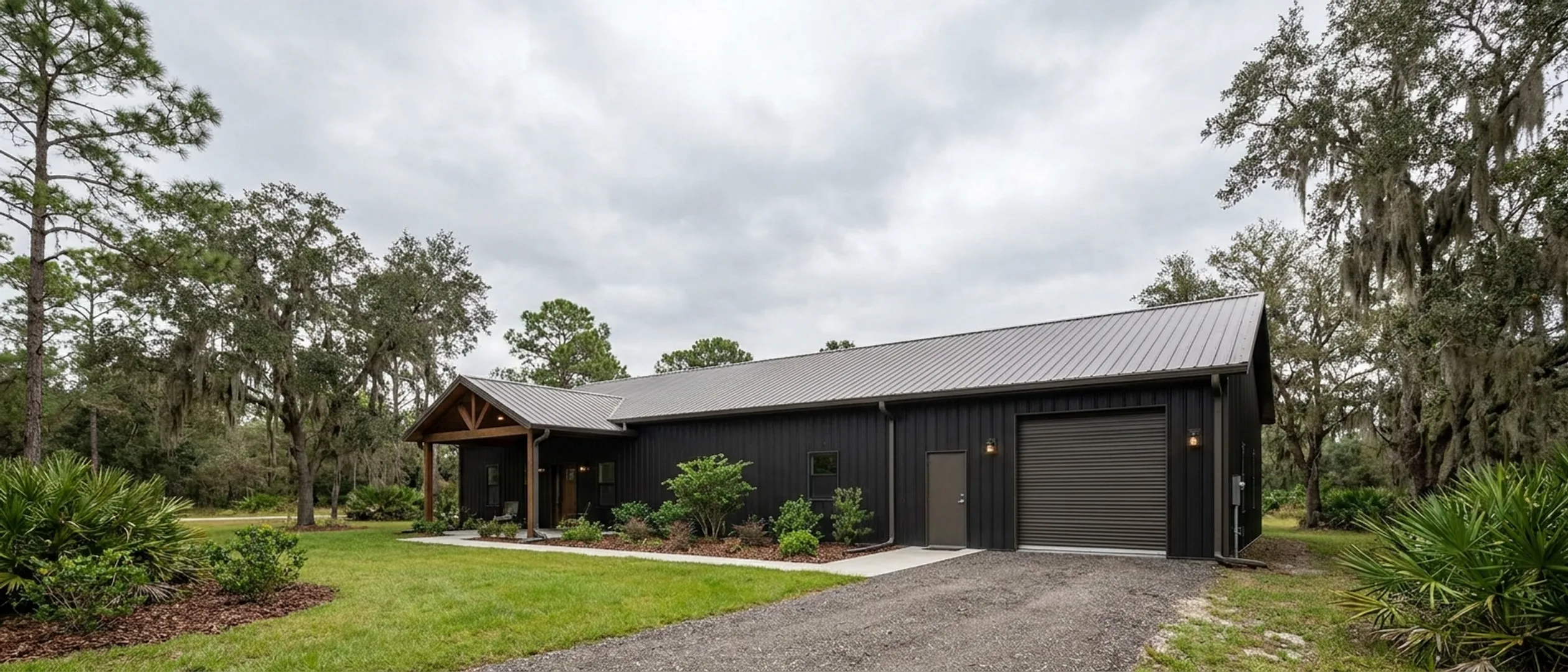
What Size Barndominium Can You Build for Your Budget?
This is arithmetic, not an estimate. Every figure below comes from dividing a budget by the same published cost ranges in our cost guide, and none of them include your land, your site work or your utility runs. Read the exclusions at the bottom before you trust any number here, because that is where most budgets actually break.
Bottom line up front
- At a turnkey mid-grade finish, 200,000 dollars reaches roughly 1,080 to 1,670 square feet and 300,000 dollars roughly 1,620 to 2,500.
- The same budgets buy several times that square footage as shell only, but a shell is a weatherproof structure with no slab, systems or interior, not a habitable house.
- None of those figures include land, site work, utility runs or impact fees, which swing by tens of thousands of dollars between Florida counties.
Figures below are industry data from cited third-party sources, not a quote from Florida Barndominium Builders. Every project is priced individually.
Read the tier before you read the number
The same budget buys wildly different square footage depending on what you are actually buying, and conflating the three is the most common budgeting mistake on this topic.
Shell only, roughly 28 to 35 dollars per square foot
An engineered steel frame and envelope. No slab, no plumbing, no electrical, no insulation, no interior. This is a weatherproof structure standing on a foundation you paid for separately, and it is not somewhere you can live. It is a legitimate starting point if you intend to finish the interior yourself over time, and it is the number that makes barndominiums look impossibly cheap online. See barndominium kits for what is genuinely in the box.
Turnkey mid-grade, roughly 120 to 185 dollars per square foot
A finished, move-in-ready home under a single contract, at a normal quality of finish. This is the tier most people actually mean when they ask what a barndominium costs, and it is the one to use for planning unless you have a specific reason not to. Our turnkey builds page covers what that contract includes.
Premium, roughly 225 to 350 dollars per square foot
High-end finishes, custom millwork, elevated fixtures and specification throughout. Worth stating plainly: at this tier a barndominium carries no cost advantage over conventional construction, so choose it because you want the building type, not because you expect to save money. See luxury barndominiums for what that level involves.
What each budget buys
Budget divided by cost per square foot. These are calculated from the ranges above rather than measured from published size-specific data, and they are building-only figures.
150,000 dollars
Shell only: roughly 4,300 to 5,400 square feet of structure. Turnkey mid-grade: roughly 810 to 1,250 square feet of finished home. Premium: roughly 430 to 670 square feet. At this budget the realistic finished outcome is a compact one or two bedroom home, or a larger shell you finish yourself over several years. A 30x40 footprint at 1,200 square feet sits right at the top of the mid-grade band.
200,000 dollars
Shell only: roughly 5,700 to 7,100 square feet. Turnkey mid-grade: roughly 1,080 to 1,670 square feet. Premium: roughly 570 to 890 square feet. This is the budget where a genuinely comfortable finished home becomes realistic at mid-grade, and it is the most-asked budget of the four. Expect a two to three bedroom layout rather than the sprawling shop-and-house combination the shell column implies.
250,000 dollars
Shell only: roughly 7,100 to 8,900 square feet. Turnkey mid-grade: roughly 1,350 to 2,080 square feet. Premium: roughly 710 to 1,110 square feet. At the top of the mid-grade band this reaches around 2,000 square feet finished, which is where a 40x60 layout with both living space and a real shop bay starts to become achievable.
300,000 dollars
Shell only: roughly 8,600 to 10,700 square feet. Turnkey mid-grade: roughly 1,620 to 2,500 square feet. Premium: roughly 860 to 1,330 square feet. For comparison, the average conventional home in the Census data is 2,647 square feet, so a mid-grade barndominium at this budget lands just under an average American house. That is the fair way to read this figure.
What none of those numbers include
Every figure above is the building. These are the costs that sit on top, and leaving them out is how a budget that looked comfortable stops working halfway through.
The land, and what it costs to make it buildable
Clearing, fill, drainage, septic, well and the length of the utility run are the least predictable line items on any rural build. A cleared lot beside an existing power pole and raw acreage half a mile from one are not remotely comparable, and no honest guide can put a number on this without seeing the parcel. Our site preparation page covers what actually gets priced.
Foundation type, which your flood zone may decide for you
A monolithic slab is typical and comparatively economical. A raised or pier foundation, which mapped flood zones in Florida frequently require, costs materially more and is a parcel question rather than a preference. This single item can move a total more than choosing a different finish level would.
Impact fees, which vary enormously by county
Impact fees swing by tens of thousands of dollars between Florida counties for an identical house. This is a genuine budget item, not a rounding error, and it is decided entirely by where you build. The service area pages carry the specifics county by county.
The hurricane engineering your address requires
Designing for the wind speed at your specific address is a real cost, and in Miami-Dade and Broward the High Velocity Hurricane Zone regime adds heavier requirements again. It applies to conventional construction too, so it is not a barndominium penalty, but it is not included in any per-square-foot figure on this page.
Reading this because you are weighing a build? The next step is a plan drawn for your program.
Pros and cons, honestly
Pros
- At mid-grade finish, a 300,000 dollar budget reaches roughly 1,620 to 2,500 square feet, just under the 2,647 square foot average American home in Census data.
- The shell-only route lets you buy a large structure now and finish the interior over several years as funds allow.
- Cost per square foot falls as the building gets simpler, so a straightforward rectangular footprint stretches a budget further than a complex one.
- Combining living space and workshop under one roof avoids paying twice for two separate structures and two sets of utility runs.
Cons
- The shell-only column is not a habitable house, and reading it as "what my budget builds" is the single most common way these figures get misused.
- Land, site work, septic, well and utility runs sit outside every number here and are the largest wildcard on any rural build.
- A raised or pier foundation required by a mapped flood zone can move the total more than choosing a different finish tier would.
- Impact fees vary by tens of thousands of dollars between Florida counties for the same house.
- At premium finish, the square footage a budget reaches is small enough that conventional construction is worth comparing seriously.
Common questions
5 questions people ask most about barndominium cost. If yours is not on the list, ask it directly.
How big of a barndominium can I build for 200,000 dollars?
What would a 300,000 dollar barndominium look like?
Can I build a barndominium for 100,000 dollars?
Why is the shell-only figure so much bigger than the finished one?
Are these numbers a quote?
Questions answered? Tell us what you want to build and we will put real numbers against it.
Keep reading
The pages that answer the next question this one raises.
Barndominium Cost Guide
The sourced ranges these calculations come from, with a calculator that runs the same maths on any square footage.
Read itCheaper Than a House?
How these tiers compare against real conventional-construction data, and the finish level where the advantage disappears.
Read itFloor Plans
What these footprints actually look like laid out, from a 30x40 through to a 40x60 with a working shop bay.
Read itWant a real number instead of a range?
Start your plans and we will come back with a budget for what you actually want to build, not a national average. Send the parcel ID or an address when you have one and we will price it against your land. That conversation costs nothing.