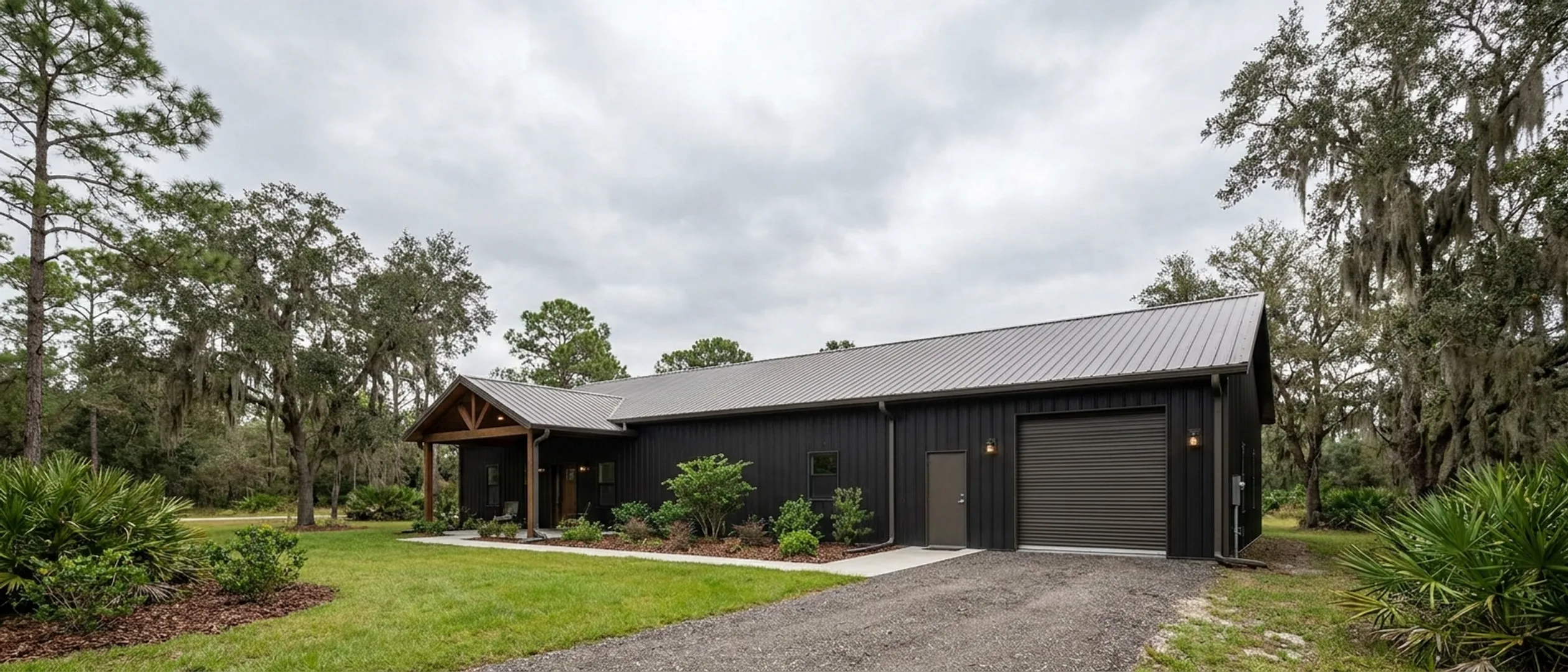
Is a Barndominium Cheaper Than a House?
The honest answer is yes at a mid-grade finish, and no at a premium one. That second half rarely gets said, which is why people budget for a barndominium expecting a discount that their finish schedule quietly cancels out.
Bottom line up front
- Yes at a mid-grade finish: 120 to 185 dollars per square foot against NAHB's 162 dollar national average and 155 in the South Atlantic region that includes Florida.
- No at a premium finish of 225 to 350 dollars per square foot, where the cost advantage disappears entirely.
- The cheap figures quoted online are shell-only, and the shell is just 15 to 40 percent of the finished cost.
Figures below are industry data from cited third-party sources, not a quote from Florida Barndominium Builders. Every project is priced individually.
The numbers, side by side
Conventional construction has a well-measured national dataset. Barndominium figures are industry-consensus ranges rather than a single survey, so treat the comparison as directional and read the tiers carefully.
What conventional construction actually costs
NAHB's 2024 Cost of Constructing a Home survey, built on the Census Bureau Survey of Construction and published in January 2025, puts average stick-built construction at 162 dollars per square foot, on an average home of 2,647 square feet and an average total of 428,215 dollars excluding land. That is the highest figure in that survey's history, and it is the number a barndominium has to beat to be called cheaper.
The Florida-relevant regional figure is lower
NAHB's October 2025 regional breakdown puts the custom-home median at 166 dollars per square foot nationally, but the South Atlantic region, which includes Florida, runs 155 dollars per square foot. Florida is a comparatively lower-labour-cost building market outside its highest-demand metros, so the bar a barndominium has to clear here is slightly lower than the national one.
Where a mid-grade barndominium lands
A turnkey barndominium at a mid-grade finish converges around 120 to 185 dollars per square foot across published guides. Against 155 dollars in the South Atlantic and 162 nationally, the bottom of that range is a genuine saving and the top of it is not. The spread is wide because "barndominium" covers everything from a bare shell to a fully finished custom home, which is the whole reason a single average is unhelpful here.
Where the advantage disappears
Premium and high-end turnkey barndominiums run 225 to 350 dollars per square foot. At that level there is no cost advantage over conventional construction at all, because you are no longer buying a simpler building, you are buying an expensive interior wrapped in a different structural system. Anyone budgeting a high-end barndominium on the assumption of a discount is budgeting wrong.
Why the shell price misleads people
Almost every disappointed barndominium budget traces back to this one misunderstanding, so it is worth being blunt about it.
The shell is a small share of the finished cost
An engineered steel shell runs roughly 20 to 50 dollars per square foot, clustering around 28 to 35 for a straightforward rectangular building. But the shell represents only 15 to 40 percent of total finished cost, which means 60 to 85 percent of the money goes into foundation, mechanical, electrical, plumbing, insulation and interior finish. The cheap number you saw quoted was almost certainly the shell. Our barndominium kits page explains exactly what a kit does and does not include.
Interior finish dominates both construction types
In NAHB's own stage breakdown, interior finishes are the single largest cost stage of a conventional home at 24.1 percent of total, ahead of major systems rough-in at 19.2 percent and framing at 16.6 percent. Framing is not where houses get expensive. That is why swapping the framing method saves less than people expect, and why the finish level you choose moves your total more than steel-versus-stick ever will.
A blended per-square-foot figure hides the shop
Guides quoting a very low cost per square foot are often averaging conditioned living space together with unfinished shop bay. A 5,000 square foot building that is 2,500 square feet of shop reads cheap per square foot precisely because shop space costs a fraction of finished living space. The blended average understates what the living quarters actually cost, so compare living-space cost to living-space cost or the comparison is meaningless.
What genuinely does save money
The real structural advantage is not the framing, it is getting a home and a workshop under one roof, on one foundation, with one set of utility runs, instead of paying for a house and then a separate outbuilding. If you need the shop, that consolidation is where the economics actually work in your favour. Our shouses page covers that combined layout specifically.
Florida changes the comparison in both directions
National cost content ignores this, and in Florida it is not ignorable.
The hurricane code applies to both, not just to one
Engineering a home for the design wind speed at its address adds cost, and it adds cost to conventional and steel construction alike. This is not a barndominium penalty. What differs is the detail of how each system gets there, which is why the wind rating is a specification conversation about your parcel rather than a fixed adder we could quote on a page.
Site work is the largest wildcard on either building
Clearing, fill, drainage and the length of the utility run are unpredictable until a specific parcel is evaluated, and no national cost guide can responsibly assign a number to them. A cleared lot next to a power pole and raw acreage half a mile from one are not comparable line items. This sits outside every per-square-foot figure on this page, for both construction types. See site preparation for what actually gets priced.
Foundation type can swing the comparison
A monolithic slab is one of the cheaper foundations and is typical for post-frame and barndominium construction. A raised or pier foundation, which flood-zone Florida parcels frequently require, costs materially more. That is a parcel question rather than a building-type question, and it can move your total more than the framing decision does.
Reading this because you are weighing a build? The next step is a plan drawn for your program.
Pros and cons, honestly
Pros
- At a mid-grade turnkey finish, 120 to 185 dollars per square foot genuinely undercuts conventional construction at 162 nationally and 155 in the South Atlantic region.
- Getting living space and workshop under one roof, one foundation and one set of utility runs is a real saving against building a house plus a separate outbuilding.
- A monolithic slab, typical for this construction type, is one of the cheaper foundation options in NAHB stage data.
- Factory-fabricated components arrive cut and ready, which reduces on-site waste compared with stick framing.
Cons
- At a premium finish of 225 to 350 dollars per square foot there is no cost advantage over conventional construction whatsoever.
- The attractive per-square-foot figures people quote are usually shell-only, and the shell is just 15 to 40 percent of the finished cost.
- Blended per-square-foot numbers that average finished living space with unfinished shop bay systematically understate the cost of the living quarters.
- Interior finish is the largest cost stage in both construction types, so changing the framing method saves less than most people assume.
- Site work, land and utility runs sit outside every figure here and are the largest wildcard on either building type.
Common questions
5 questions people ask most about barndominium cost. If yours is not on the list, ask it directly.
So is a barndominium cheaper to build than a house or not?
Why do I keep seeing barndominiums advertised at 30 dollars a square foot?
Does the hurricane code make a barndominium more expensive than a regular house in Florida?
Where does the money actually go, if not into the frame?
What is the cheapest honest way to build one?
Questions answered? Tell us what you want to build and we will put real numbers against it.
Keep reading
The pages that answer the next question this one raises.
Barndominium Cost Guide
The full sourced ranges by tier and by size, with a calculator that multiplies those same cited figures.
Read itWhat Your Budget Actually Builds
The same ranges run backwards: what square footage 150k, 200k, 250k and 300k realistically buys at each tier.
Read itBarndominium Pros and Cons
Maintenance schedules, lifespan data, energy tradeoffs and the HOA gate that county zoning approval does not clear.
Read itWant a real number instead of a range?
Start your plans and we will come back with a budget for what you actually want to build, not a national average. Send the parcel ID or an address when you have one and we will price it against your land. That conversation costs nothing.