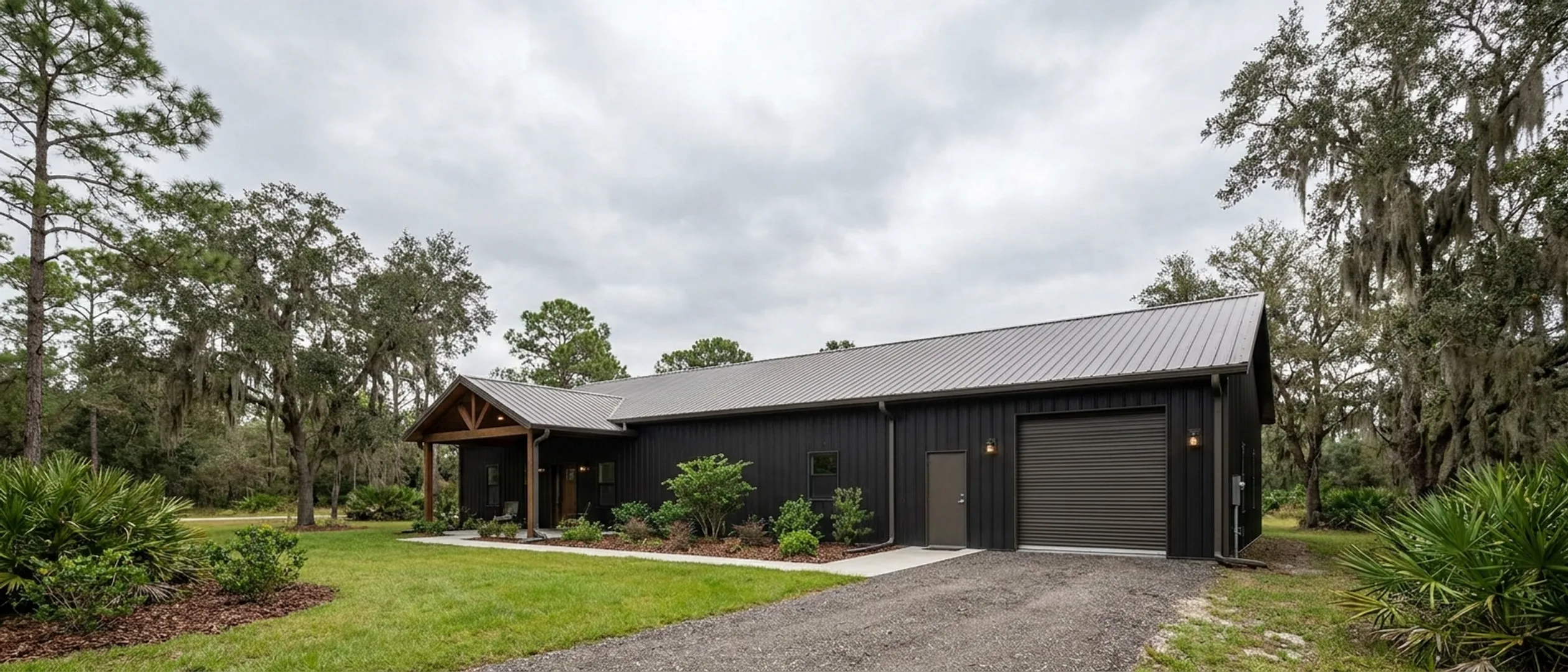
How Much Does a Barndominium Cost?
The honest answer is a wide range, because "barndominium" covers everything from a bare steel shell to a fully custom finished home, and the finish decides most of the total. Here is what national cost data says, and what Florida adds that most guides never mention.
Bottom line up front
- Published cost guides put a shell or kit at $20 to $50 per square foot, a turnkey mid-grade build at $120 to $185, and a premium finish at $225 to $350.
- The shell is only 15 to 40 percent of the finished total, so a kit price is not a house price.
- Florida adds roughly 5 to 10 percent for inland hurricane-code construction, plus impact fees that swing more than $20,000 by county alone.
Figures below are industry data from cited third-party sources, not a quote from Florida Barndominium Builders. Every project is priced individually.
Cost per square foot, by tier
The spread is wide because "barndominium" covers everything from a bare shell to a fully finished custom home. Tier is what actually explains the range, not location.
| Tier | Range | Source |
|---|---|---|
| Shell / kit only | $20–$50 per sq ft | Kit suppliers and industry cost-data publishers, 2026 — a straightforward rectangular shell typically clusters $28–$35/sq ft |
| Turnkey, mid-grade finish | $120–$185 per sq ft | Angi and Rocket Mortgage cost guides, 2026 |
| Turnkey, premium finish | $225–$350 per sq ft | Industry cost-data publishers, 2026 |
Estimate a range for your square footage
Pick a size and a tier and this multiplies them against the same industry ranges printed in the table above, nothing new, nothing ours. It's a starting orientation, not a quote.
Estimated range
$0 – $0
This estimate comes from the industry cost data cited in the table above, not from Florida Barndominium Builders. It doesn't account for your site, county, or finish choices, all of which move the real number. Send us the parcel for one that does.
Total cost by size
Rough totals at common sizes. These move with everything on this page, so treat them as a starting orientation, not an estimate for your project.
1,200 sq ft
$112,800–$144,000
Angi cost guide, 2026
1,500 sq ft
$150,000–$225,000
Industry cost-data publishers, 2026
2,000 sq ft
$200,000–$300,000
Industry cost-data publishers, 2026
2,500 sq ft
$250,000–$375,000
Calculated from the typical per-square-foot range above; not independently published at this exact size
3,000 sq ft
$300,000–$450,000
Calculated from the typical per-square-foot range above; not independently published at this exact size
4,200 sq ft
$394,800–$504,000
Angi cost guide, 2026
What actually moves the number
Finish level
The shell is typically only 15-40% of the finished total. The rest, foundation, mechanical and electrical, insulation, interior finish, is where two barndominiums with an identical footprint end up six figures apart. Square footage is the number everyone leads with; finish level is the one that actually moves the total.
Region and labor market
Construction cost tracks regional labor and material pricing everywhere, not just here. National survey data puts the South Atlantic region, which includes Florida, at roughly $155/sq ft for custom-home construction against a $166/sq ft national median. That is a real, measurable baseline, separate from the wind-specific costs below.
Shop-to-living ratio
A quoted low cost-per-square-foot often blends cheap unfinished shop space with conditioned living space, which understates what the living quarters alone actually cost. Ask what share of the total square footage is genuinely conditioned before comparing two quoted numbers against each other.
Site work and foundation
The largest wildcard in every cost estimate, and the reason no national guide can responsibly price a specific project sight unseen. Clearing, fill, drainage, and utility run length vary enormously by parcel, and a raised or pier foundation, common on Florida flood-zone lots, costs materially more than the monolithic slab most cost guides assume by default.
Reading this because you are weighing a build? The next step is a plan drawn for your program.
What's different about Florida
The hurricane-code premium
Wind engineering, connection detailing, and the labor to execute a properly wind-rated assembly typically add somewhere in the order of 5 to 10 percent to an inland Florida build, and more inside the High Velocity Hurricane Zone. The hardware itself, the straps and clips, is a small fraction of that. The real cost is the engineering and the labor to install it correctly, not the hardware line item, which is worth knowing before assuming a "hurricane-rated" quote is inflated.
Wind mitigation inspection
A standalone wind mitigation inspection runs roughly $75-175, or $125-250 bundled with a four-point inspection. It is a post-construction cost, not a building cost, but it is the mechanism that turns a well-built, properly strapped structure into an actual insurance discount, insurance-industry sources report potential premium savings in the 25-45% range from a strong report.
HVHZ approval in Miami-Dade and Broward
Inside the High Velocity Hurricane Zone, expect the approval pathway itself to add both cost and lead time. Many national product approvals are explicitly scoped as not valid for HVHZ use, which makes a Miami-Dade NOA the document that actually matters for a lot of building products there, not a formality layered on top of a standard approval.
Impact fees swing by tens of thousands, by county alone
This is the line item most national cost guides miss entirely. Leon County charges no impact fee at all. Orange County runs roughly $22,800 per home in combined impact fees on a rural parcel. St. Lucie County charges $17,847 outside city limits versus $13,508 for an identical home inside Port St. Lucie. Broward's surviving countywide impact fee, school fees only, runs $8,809-$11,070. That is a $20,000-plus swing driven entirely by jurisdiction, before a single design decision is made.
Pros and cons, honestly
Pros
- Genuinely lower cost per square foot than conventional construction at a typical finish level, national custom-home construction runs a median $162/sq ft against a barndominium turnkey range of $120-185. The advantage narrows, and can disappear, at premium finish levels.
- A shop bay under the same roof as living space costs less per square foot than building a separate detached structure would.
- Steel shell erection is widely reported as faster than conventional framing, which shortens the weather-exposed stage of a build.
- Insurance is not automatically worse. Premiums typically run similar to or slightly above a conventional home of equal value, and an engineered metal frame with a documented roof attachment schedule tends to score well on the wind mitigation inspection that actually sets your premium.
Cons
- Appraisal and financing carry real friction in markets where barndominiums are uncommon. Freddie Mac lists them as an eligible non-traditional property type and Fannie Mae covers them under its unique-homes provision, but execution still depends on finding a lender and appraiser who have handled one before and can find comparable sales.
- Resale value varies sharply by market. In rural Florida counties where barndominiums are common, they sell readily. In a conventional subdivision, the buyer pool is smaller and comparables can be thin.
- The "always cheaper" claim breaks down at higher finish levels, where cost per square foot can converge with or exceed conventional construction.
- Not every insurance carrier treats barndominiums the same way. Some still price them as non-standard construction with limited actuarial history, so shopping around for a carrier familiar with the building type is worth the time.
Common questions
6 questions people ask most about barndominium cost. If yours is not on the list, ask it directly.
Does the kit price basically tell me what the house will cost?
Are barndominiums actually cheaper than a stick-built house?
Why do some quoted per-square-foot prices look so much lower than others?
How much extra does hurricane-code construction actually add in Florida?
Can I get a normal mortgage for a barndominium?
Will insurance cost more for a barndominium?
Questions answered? Tell us what you want to build and we will put real numbers against it.
Keep reading
The pages that answer the next question this one raises.
Cheaper Than a House?
These same ranges set against real NAHB conventional-construction data, and the finish level where the advantage disappears.
Read itWhat Your Budget Builds
The calculator run backwards: what square footage 150k, 200k, 250k and 300k reaches at each finish tier.
Read itHow to Finance a Barndominium
Knowing the number is half of it. Construction-to-permanent loans, VA and USDA routes, and the appraisal gap behind most declines.
Read itWant a real number instead of a range?
Start your plans and we will come back with a budget for what you actually want to build, not a national average. Send the parcel ID or an address when you have one and we will price it against your land. That conversation costs nothing.