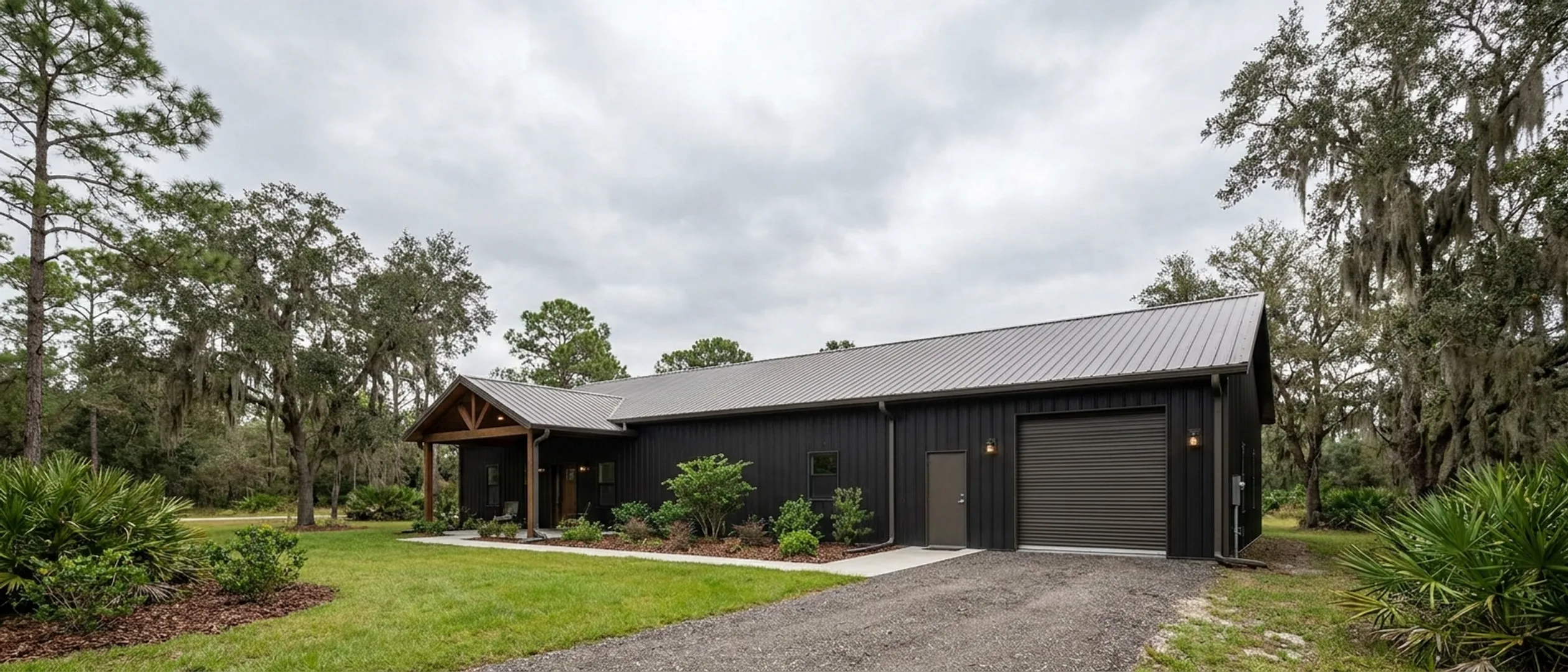
How to Finance a Barndominium
Most people are told barndominiums are hard to finance, then never told why. Freddie Mac's own guidelines already treat this building type as eligible. What actually stalls loans is the appraisal, and there is something you can do about that before you ever apply.
Bottom line up front
- Yes, you can get a mortgage: Freddie Mac's Seller/Servicer Guide names barndominiums as an eligible non-traditional property type.
- The obstacle is the appraisal, not the loan program, and thin comparable sales are what leave borrowers covering the gap in cash.
- Lenders commonly want 10 to 15 percent of the build figure held in reserve on top of your down payment.
Figures below are industry data from cited third-party sources, not a quote from Florida Barndominium Builders. Every project is priced individually.
The obstacle is the appraisal, not the loan program
This is the single most useful thing to understand before you talk to a lender, because it changes who you approach and what you bring with you.
The secondary market already allows this building type
Freddie Mac's Single-Family Seller/Servicer Guide states that mortgages secured by non-traditional property types are eligible for delivery, and it names barndominiums specifically. That matters because it means the constraint is not a blanket rule from the top of the mortgage market. It sits with individual lender appetite and with what happens at appraisal, both of which are things you can work around by choosing the right lender and preparing the file.
What the appraisal gap actually is
An appraiser values your home by finding comparable sales nearby. Where barndominiums are uncommon, those comparables are thin, so the appraiser has to widen the search radius, look back further than the usual six months, and sometimes cross into another town or county. If the appraised value lands below what the build costs, the lender sizes the loan to the appraised value, not to your spend, and you cover the difference in cash.
The fix is comparables, gathered before you apply
Ask a local agent to pull recent sales of barndominiums and comparable rural homes within roughly 25 miles, and hand that list to your loan officer up front. Doing this before the appraisal is ordered is the difference between an appraiser starting from nothing and an appraiser starting from a defensible set of sales. It costs you a phone call and it is the highest-leverage thing you can do for the loan.
Why some lenders decline before they look
The reasons are consistent and none of them are about whether the house is sound. The builder is not a name the underwriter recognises, the construction method is steel or post-frame rather than stick-built, and the county has thin comparable sales. A lender who has closed this type of loan before has already worked through all three, which is why lender selection matters more here than on a conventional build.
The loan routes, and who each one actually fits
A ground-up build is not a mortgage. It is a construction loan that becomes a mortgage, and the program you qualify for changes the down payment more than anything else on this page.
Construction-to-permanent is the default route
This finances the build in draws as work completes, then converts to a permanent mortgage when the home is finished, so you close once rather than twice. It is the standard structure for a ground-up metal-frame or post-frame residence on land you already own or are buying at closing. If you are handing the whole project to one contractor, our turnkey builds page explains what that single contract covers, which is also what makes a lender most comfortable.
VA: the strongest option if you are eligible
For eligible veterans, active-duty service members and certain surviving spouses, a VA construction loan covers both the land and the build with no down payment and no private mortgage insurance. That combination is not available anywhere else, and it materially lowers the total cost of borrowing. If you have VA entitlement, start here before looking at anything else.
USDA: genuinely useful across rural Florida
USDA financing offers no money down for buyers within the income limits, and much of rural Florida falls inside a USDA-designated area. The conditions are specific: the parcel has to sit in a designated rural area, household income has to fall within 115 percent of the area median adjusted for household size, and the home must be your primary residence rather than a commercial or investment property. For an acreage barndominium outside a metro, this is often the best-fitting program.
FHA: possible, but lender choice is everything
FHA financing works for a barndominium, with a down payment in the 3.5 to 10 percent range depending on credit, plus mortgage insurance. The caveat is that FHA has historically been cautious about non-traditional construction methods, and not every FHA-approved lender will close this kind of construction loan. An FHA approval on the wall does not mean that particular lender will do this build.
Local banks and farm credit lenders outperform the big names
Large national banks are frequently unfamiliar with this building type, and unfamiliarity reads as risk. Local banks, credit unions and farm credit institutions lend against rural property and outbuildings routinely, so a steel home on acreage is closer to their normal business than it is to a national retail lender. In Florida specifically, farm credit lenders publish their own barndominium guidance, which tells you the product is already on their desk.
Budget a cash buffer above the build figure
Lenders commonly want to see 10 to 15 percent in reserve above the build number before they will fund, as protection against overruns. On a 400,000 dollar build that is another 40,000 to 60,000 dollars you need access to, separate from your down payment. Plan for it early, because discovering it late is what turns an approved borrower into a stalled one.
What to line up before the first conversation
Financing goes smoothly in roughly the same circumstances every time. None of it is complicated, but it is easier done in this order.
Know how the home will be classified
A barndominium on a permanent foundation, built to the Florida Building Code, is a site-built home. It is not a manufactured home and not a modular home, and that distinction drives loan eligibility directly. If a lender or an insurer has it filed under the wrong category, the terms you are quoted will be wrong too. Our guide to whether a barndominium is legal to build in Florida covers the classification question in full.
Bring sealed plans, not a concept
Underwriters and appraisers both work from documents. A complete, engineer-sealed plan set with a defined finish schedule gives an appraiser something concrete to value and gives an underwriter a scope they can hold a contractor to. Our custom plans page covers what a Florida-ready plan set includes and why the engineer seal is not optional here.
Have a realistic total, including the land and the site work
Loan applications fail on incomplete budgets more often than on credit. Clearing, fill, drainage, septic, well and the length of the utility run are the least predictable line items on any rural build and they are frequently left out of an early number. Our site preparation page covers what actually gets priced, and the barndominium cost guide has the per-square-foot ranges to build a defensible figure from.
Reading this because you are weighing a build? The next step is a plan drawn for your program.
Pros and cons, honestly
Pros
- Freddie Mac's Seller/Servicer Guide names barndominiums as an eligible non-traditional property type, so the constraint is lender appetite and appraisal, not a blanket secondary-market rule.
- VA construction loans cover land and build with no down payment and no PMI, which no other program matches.
- Much of rural Florida sits inside a USDA-designated area, putting a no-money-down route within reach for buyers under the income limits.
- Local banks and farm credit lenders already underwrite rural property and outbuildings, so this is closer to their routine business than to a national retail lender.
- The appraisal problem has a concrete, low-effort fix: comparable sales gathered and handed over before the appraisal is ordered.
Cons
- Thin comparable sales can produce an appraisal below build cost, and the lender will size the loan to the appraised value, leaving you to cover the gap in cash.
- Many large national banks decline on unfamiliarity alone, which narrows the lender pool before your file is ever assessed on its merits.
- FHA has historically been cautious on non-traditional construction, and an FHA-approved lender is not necessarily a lender that will close this build.
- Lenders commonly want 10 to 15 percent in reserve above the build figure, which is real cash on top of the down payment.
- USDA carries genuine restrictions: designated rural area, income within 115 percent of area median, and primary residence only.
Common questions
6 questions people ask most about barndominium cost. If yours is not on the list, ask it directly.
Can you actually get a mortgage on a barndominium?
What is the appraisal gap, in plain terms?
Can I use a VA loan to build a barndominium?
Does a USDA loan work for a barndominium in Florida?
Why do big banks keep turning me down?
How much cash do I need beyond the down payment?
Questions answered? Tell us what you want to build and we will put real numbers against it.
Keep reading
The pages that answer the next question this one raises.
Barndominium Cost Guide
The sourced per-square-foot ranges to build a defensible loan figure from, plus a calculator that works from those same numbers.
Read itIs It Legal in Florida?
Classification drives loan eligibility. This covers why a barndominium is a site-built home rather than a manufactured or modular one.
Read itTurnkey Builds
A single contract from lot to certificate of occupancy, which is also the structure lenders are most comfortable underwriting.
Read itWant a real number instead of a range?
Start your plans and we will come back with a budget for what you actually want to build, not a national average. Send the parcel ID or an address when you have one and we will price it against your land. That conversation costs nothing.