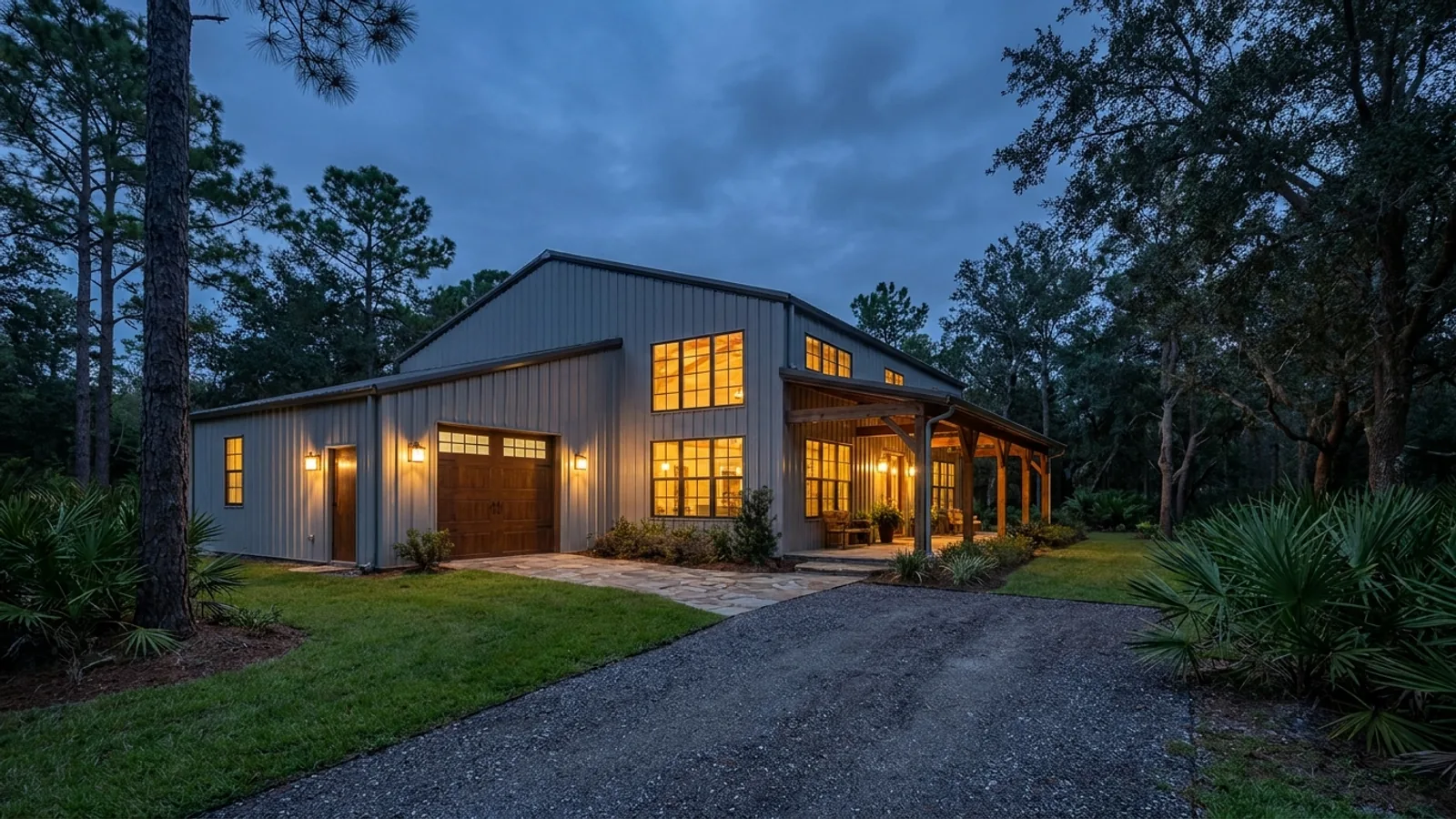
Barndominium Builders in Jacksonville, FL
Duval County is the one market on our list where the acreage and city hall share the same government. The 1968 Jacksonville-Duval County Consolidation merged city and county into a single 874-square-mile jurisdiction, the largest total area of any city in the contiguous United States, which means the AGR-zoned rural acreage out past Cecil Field, Baldwin, and Whitehouse is permitted by the same Building Inspection Division, the same zoning code, and the same wind-speed ordinance as downtown. That ordinance is unusually precise for Florida: Duval sets two different design wind speeds on either side of a line drawn up the St. Johns River and I-95, rather than leaving builders to read a statewide contour map. Four small municipalities, Baldwin, Atlantic Beach, Neptune Beach, and Jacksonville Beach, never joined the consolidation and still run their own permitting today, so confirming jurisdiction against the parcel, not the mailing address, still matters here too.
Building conditions in Jacksonville
What actually changes from one Florida city to the next: who issues the permit, what wind speed the structure has to be engineered to, and what the ground is like. These are the numbers your drawings have to satisfy.
Duval County Ordinance Code § 320.103, last amended by Ordinance 2012-214-E, jacksonville.elaws.us. Do not use the older 2007 UF GeoPlan Duval wind speed map, which shows a different, superseded demarcation line and pre-2010-code values.
Building Inspection Division, Ed Ball Building, 214 N. Hogan St., 904-255-8500, BIDDocuments@coj.net. The exception is a parcel inside Baldwin, Atlantic Beach, Neptune Beach, or Jacksonville Beach, permitted by that municipality directly; confirm jurisdiction against the city GIS parcel lookup at maps.coj.net, not the mailing address.
Jacksonville Zoning Code § 656.331(d)(2). A separate 'two acres' figure at § 656.401(g)(2)(i) applies only to churches seeking a use-by-exception across ten districts including AGR, not to AGR's general residential minimum; do not quote it as the district's lot size.
City of Jacksonville consolidation history, Laws of Florida Ch. 67-1320; multiple secondary sources cross-checked. The 874 sq mi figure is the commonly cited total-area number; a land-only figure closer to 747 sq mi also appears in some sources.
Impact-fee aggregator sourcing, rates cited 5 August 2026. The Mobility Fee is zone-based across 10 mobility zones administered by CMMSO (904-255-8330); we confirm the actual zone rate for a specific parcel before quoting a number.
Florida DEM/FGS Subsidence Incident Report database via secondary mapping aggregators.
Also worth knowing before you build in Jacksonville
- Four cities that never consolidated
- Baldwin, Atlantic Beach, Neptune Beach, and Jacksonville Beach voted against joining the 1968 consolidation and still run their own zoning, permitting, and flood rating today, about 6% of county population. None of the four is where the AGR acreage market is, but if a parcel falls inside one, this page's figures do not apply.
- RR-Acre, the smaller-lot rural alternative
- A 1-acre minimum lot, 100 ft width, 25% maximum lot coverage, and the same 35 ft height cap as AGR, for a buyer who wants acreage without full agricultural-use rights.
- No minimum living area found in AGR or RR-Acre
- Consistent with the pattern in our other north Florida markets, Alachua and Marion, neither AGR nor RR-Acre sets a minimum dwelling square footage in the text we reviewed.
- The agricultural exemption does not cover a dwelling
- F.S. 604.50 exempts a bona fide nonresidential farm building, a barn, greenhouse, or storage building, from the building code and permit fees, never a residence. No Duval ordinance broadens this.
- Ground conditions: high water table, not karst
- Duval's rural AGR land sits on Atlantic Coastal Flatwoods soils, Leon, Pottsburg, Sapelo, Ridgeland, and Mandarin, typically poorly to somewhat-poorly drained with a seasonal high water table within about 18 inches of the surface. That is close to the opposite of Marion's excessively-drained Candler sand, and a site-specific geotechnical investigation with a raised or engineered foundation should be treated as the norm here, not the exception.
- Termite protection is mandatory
- All of Florida is Termite Infestation Probability Zone 1, Very Heavy. Registered termiticide treatment plus a Certificate of Compliance is required on every new dwelling, no Duval-specific variation found.
- Building permit fee
- Set by formula under Ordinance Code § 320.409, with current dollar figures published at coj.net/fees rather than fixed in the ordinance text. The minimum residential permit fee is $95.00, effective June 2025.
- Rainfall
- Approximately 53.5 inches of annual precipitation.
- Measured hurricane wind, against the design number
- Hurricane Irma (2017) brought sustained winds of 59 mph with an 86 mph gust at Jacksonville International Airport, and a sustained 68 mph with an 87 mph gust at the Mayport ASOS station. Hurricane Matthew (2016) brought 61 mph sustained with gusts to 76 mph at the Jacksonville Beach Pier, easing to 41 mph sustained inland at Craig Airport. Every measured gust we found stayed meaningfully below the 125-130 mph design wind speed.
- Flood insurance discount and claims history
- City of Jacksonville, the consolidated jurisdiction covering essentially all AGR/RR rural land, holds a Community Rating System Class 6, a 20% NFIP premium discount inside the flood hazard area. Duval County has recorded roughly 6,060 NFIP flood claims totaling about $214 million paid since 1978, with 2017's Hurricane Irma the single highest claims year.
- Population and permit activity
- Duval County's population is approximately 1,023,153, the 6th most populous county in Florida, up 9.3% from 2019 to 2024. Building permits for all structure types ran 9,811 in 2023 and dropped to 6,495 in 2024, a real swing worth factoring into market timing.
City of Jacksonville consolidation history; jurisdiction should be confirmed against the GIS parcel lookup, not the mailing address.
Jacksonville Zoning Code § 656.304.
Jacksonville Zoning Code §§ 656.331, 656.304.
F.S. 604.50, applied statewide.
USDA NRCS Official Series Descriptions for the Leon, Pottsburg, Sapelo, Ridgeland, and Mandarin series.
Florida Building Code Residential R318.1 (8th Edition, 2023); HUD TIP Zone map.
Jacksonville Ordinance Code § 320.409 and § 106.112.
NOAA NCEI 1991-2020 Climate Normals, Jacksonville International Airport station (GHCND:USW00013889).
NWS Jacksonville storm reporting for Irma and Matthew. Hurricanes Ian (2022) and Milton (2024) were primarily rain events for this county.
FEMA Community Rating System; FEMA/NFIP claims-history aggregation. The three independent beach municipalities carry separate ratings.
U.S. Census Population Estimates Program, Vintage 2024; Census Building Permits Survey via FRED, series BPPRIV012031.
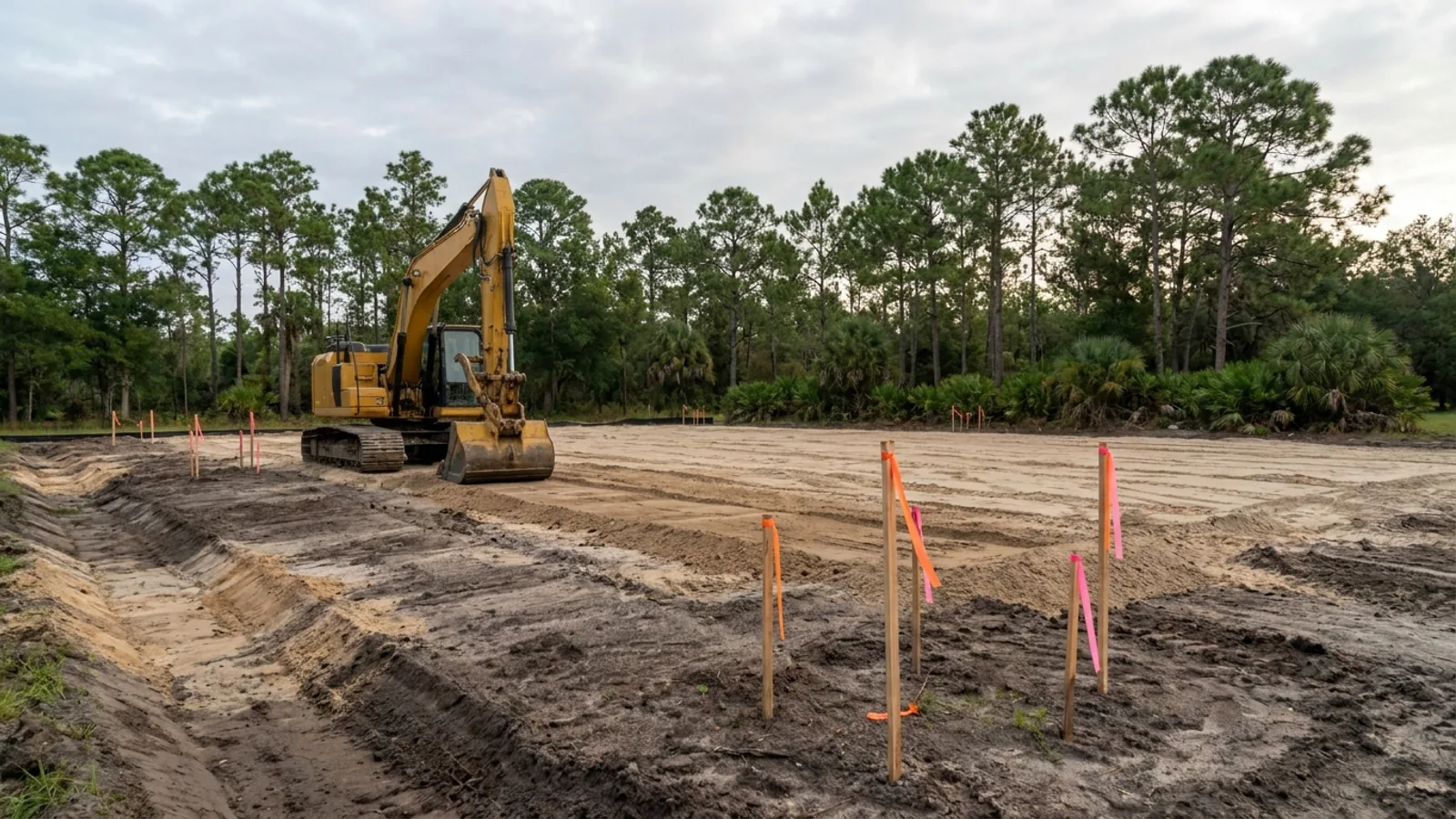
The expensive surprises are in the ground, not the building
Most of Duval County rates poorly for dwellings in the soil survey, and the reason is water sitting close to the surface rather than weak ground. That makes the pad elevation and the drainage plan the two line items most likely to move your budget. We price the dirt before we price the building.
What we build in Jacksonville
Every service we offer is available across Duval County, from a shell kit you erect yourself to a finished home we hand you the keys to. What a build costs depends far more on the parcel than on square footage, so we price against your land rather than publishing a rate card.
See all nine servicesWhat a build looks like
Three stages every Jacksonville project passes through, from a raw parcel to a finished home. Site work first, because that is where the budget is decided.
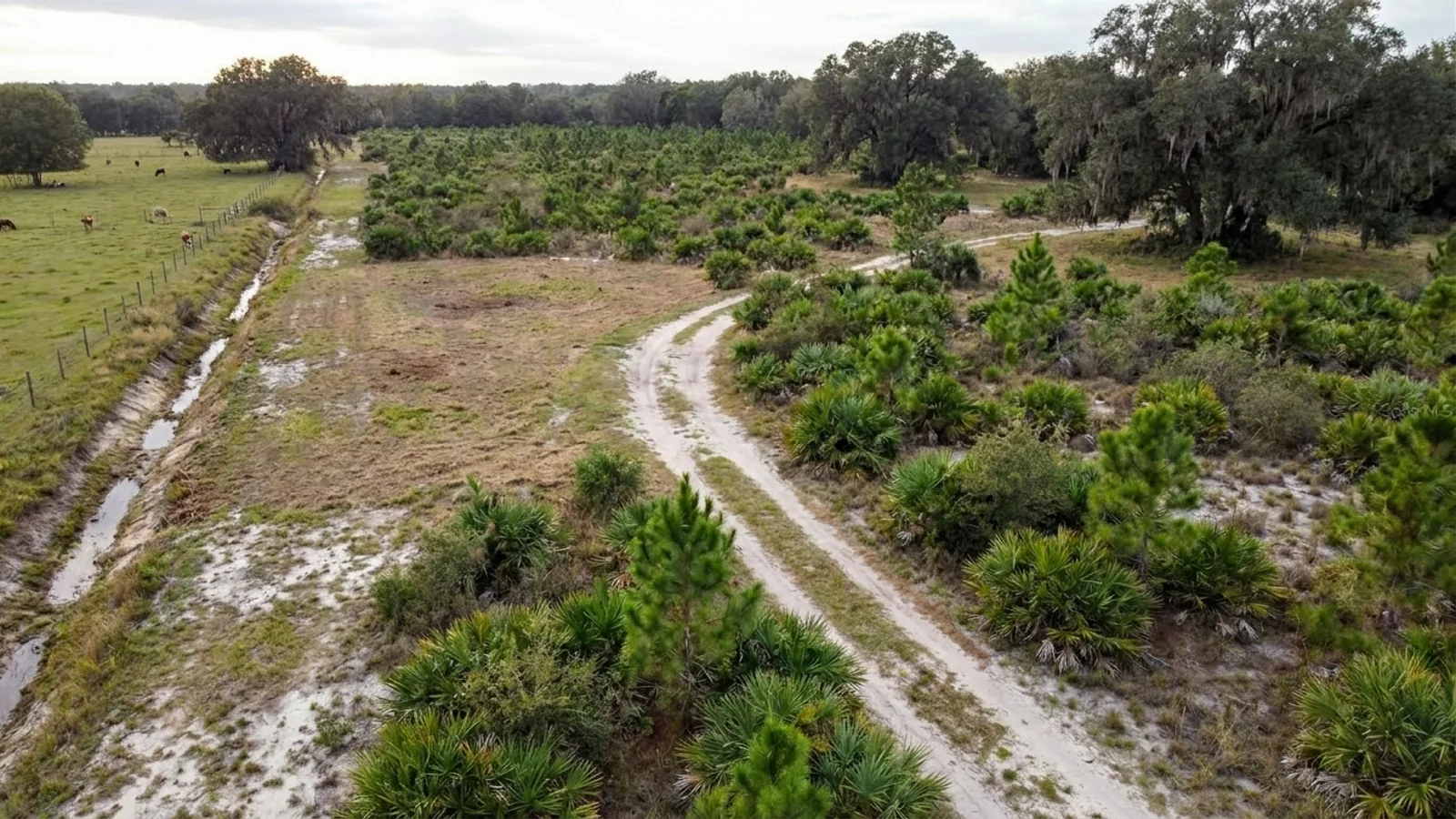
The parcel
Zoning, setbacks, flood zone and utility access get checked before anything is drawn.
Pad and permit
Clearing, grading and a compacted pad, while the submittal works through Duval County.
Frame to finish
Shell erected and dried in, then systems, insulation and interior finish through to CO.
Those are the rules for Duval County. Tell us what you want to build and we will draw it to them.
Where we build around Jacksonville
Duval County and the rural land around it. The buildable acreage for a project this size usually sits outside the city limits, which is frequently what changes who issues your permit.
Keep reading
The questions that usually come next once you know what Jacksonville allows.
Barndominium Cost Guide
Sourced per-square-foot ranges by tier and by size, with a calculator built on the same figures.
Read itIs It Legal in Florida?
Classification, zoning, the HOA gate, and the agricultural exemption that does not cover a home.
Read itHow Long Does It Take?
Census build-duration data, and the Florida statute capping permit review at 30 business days.
Read itSources for this page
The primary documents behind the Jacksonville figures above. We would rather you checked them than took our word for it.
- Duval County Code of OrdinancesZoning districts, minimum lot sizes, setbacks and height limits, as adopted.library.municode.com
- Duval County Building DepartmentThe authority that reviews and issues the permit for unincorporated parcels.jacksonville.gov
- Florida Statute 553.792The 30-business-day permit review clock, and the 10% fee reduction per day a jurisdiction runs late.flsenate.gov
- Florida Building CodeThe adopted code itself, including the wind-speed figures and the High Velocity Hurricane Zone definition.floridabuilding.org
- ASCE 7 Hazard ToolLook up the ultimate design wind speed at a specific address rather than reading it off a contour map.asce7hazardtool.online
Nearby areas we build in
Close to Jacksonville, though the permitting authority and wind requirements can differ once you cross a county line.
Building in Jacksonville: common questions
10 questions we get asked most often about building in Jacksonville. If yours is not on the list, ask it directly.
How much land do I need to build a barndominium in Duval County?
Who issues my permit, the city or the county?
What wind speed does my building have to be engineered to?
Do I need impact windows out on rural Duval acreage?
What do the impact fees add up to?
Is there really working rural land inside Jacksonville city limits?
What's the ground like on rural Duval acreage?
Should I be worried about sinkholes?
Can I build the shop or barn before the house?
What will my building permit actually cost?
Building in Jacksonville?
Start with the plan. Tell us what you want to build and we will draw it, then confirm what Duval County will actually let you put on the parcel and what wind load it has to meet. That conversation costs nothing.