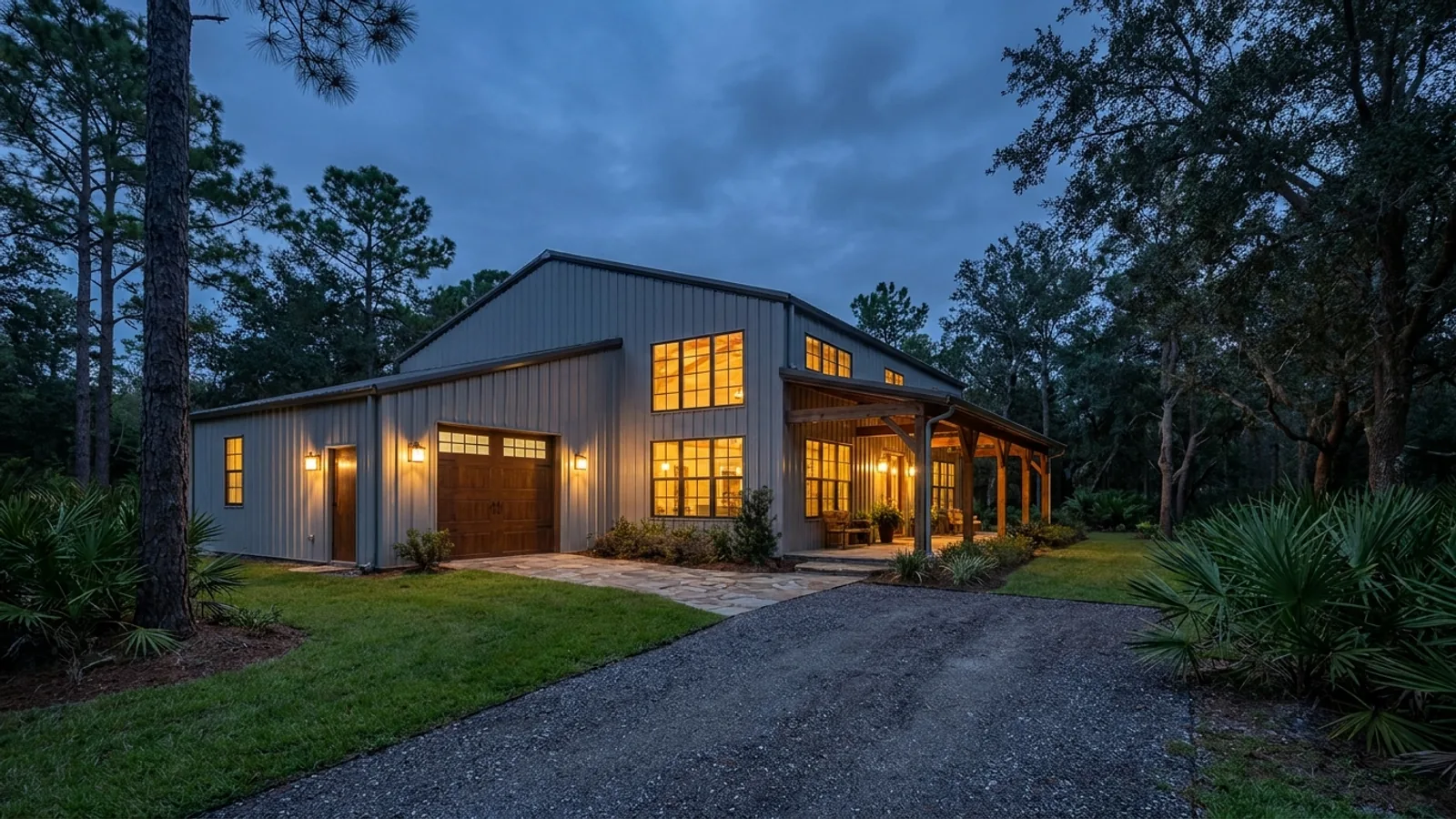
Barndominium Builders in Palm Coast, FL
Palm Coast is a single, unusually large planned community: ITT Corporation and William Levitt's Levitt & Sons platted roughly 42,000 acres into more than 40,000 individual quarter-acre lots starting in 1969, and the city that incorporated from that plat in 1999 carries no agricultural or rural-residential zoning district of its own, every parcel inside city limits falls under an inherited urban single-family designation. Real acreage sits west of the platted grid, in unincorporated Flagler County's AC, AC-2, and R-1 Rural Residential districts (1- to 20-acre minimums) around Favoretta, Espanola, Korona, Bulow, and Daytona North. Flagler County has its own specific local-government story worth knowing before you budget a build: the Board of County Commissioners suspended the unincorporated county's transportation impact fee in 2012 under what became an eight-year moratorium, not restarting the process of reinstating it until commissioning a study in 2019, and Palm Coast, notably, kept collecting its own impact fees the entire time. Flagler is also one of the fastest-growing counties in Florida, adding roughly 25,000 residents between the 2020 Census and 2025, almost entirely into this single already-platted, 1970s-vintage community, which is pushing new demand toward that western acreage.
Building conditions in Palm Coast
What actually changes from one Florida city to the next: who issues the permit, what wind speed the structure has to be engineered to, and what the ground is like. These are the numbers your drawings have to satisfy.
City of Palm Coast Building Department page (palmcoast.gov/building); Flagler County Growth Management department page (flaglercounty.gov); Flagler County Code of Ordinances Ch. 8, Art. II § 8-31 (Ord. No. 2023-10, adopted 6-19-23), via Municode Library.
Historical account compiled by AskFlagler.com, cross-checked against the City of Palm Coast's current About page (palmcoast.gov/about), confirming the 1999 incorporation date.
Palm Coast Building Division, (386) 986-3780; Flagler County Code of Ordinances Ch. 8, Art. II § 8-32 (amendments through Ord. No. 2023-10; wind-speed lines set by Ord. Nos. 2020-02 and 2021-02), via Municode Library. The 8th Edition code did not raise wind speeds anywhere on the Florida peninsula, only in the panhandle, per the Florida Building Commission's own fact sheet.
FlaglerLive, 'After 8-Year Moratorium, Flagler County Will Get Back To Taxing Development for Roads and Possibly More,' October 7, 2019, citing county commission proceedings.
City of Palm Coast newsroom announcement, June 2017 (palmcoastgov.com/newsroom); FEMA CRS Eligible Communities list, April 2023 effective date, for the unincorporated county Class 6 rating.
Florida Legislature Office of Economic and Demographic Research, County Profile: Flagler County, prepared May 2026 (edr.state.fl.us), built on U.S. Census Bureau population estimates and Building Permits Survey data.
Also worth knowing before you build in Palm Coast
- Unincorporated zoning: AC, AC-2, and R-1 Rural Residential
- AC Agricultural requires a 5-acre minimum lot (4.5 acres under a specific lot-split exception), 200-foot width, 50/50/25/50-foot setbacks, and 35% maximum lot coverage; it permits single-family dwellings and mobile homes alongside bona fide agricultural uses. AC-2 Agriculture/Forestry is the larger, lower-intensity district: 20-acre minimum lot, 400-foot width, the same setbacks as AC, 25% maximum coverage. R-1 Rural Residential is meant as a transition between agricultural and urban districts for areas without central water/sewer: 1-acre minimum lot, 100-foot width, 25/20/10/25-foot setbacks, a 35-foot height cap, and single-family dwellings only, no mobile homes.
- What Palm Coast charges in impact fees
- Building a single-family detached home inside Palm Coast carries roughly $11,499 in impact fees before permit, plan-review, or utility connection charges: a $1,769.15 Park System fee, a $420.52 Fire and Rescue fee, and a $3,311.00 Transportation fee (effective 1/1/2023), all set by the city, plus countywide fees collected by the city, a $5,450.00 Educational Facilities fee to the Flagler County School District, a $268.00 Library fee, a $62.00 EMS fee, and a $218.00 Law Enforcement fee.
- Unincorporated county impact fees
- Unincorporated Flagler County shares the same countywide Library, EMS, Law Enforcement, and Education impact fees that apply inside Palm Coast, since those are county fees regardless of which jurisdiction collects them. The county's transportation impact fee was reinstated following the 2019 Tindale Oliver study after the eight-year moratorium described above; we confirm the current rate directly with Flagler County Growth Management before pricing a project on unincorporated land.
- City building permit fee structure
- Palm Coast bases permit valuation on the ICC's published August Building Valuation Data tables. For a one- or two-family dwelling: plan review runs $0.78 per $1,000 of valuation ($65 minimum) plus a $30 site-plan review where applicable, inspection runs $2.75 per $1,000 of valuation, and a $30.00 administrative fee applies to residential/agriculture buildings, on top of the two statewide statutory surcharges (1.5% Building Code Administrators and Inspectors Fund, 1.5% Florida Building Commission/DCA surcharge) that apply to every Florida building permit. A roughly 50% fee reduction applies when a residential private provider handles plan review and/or inspections.
- County permit fees are set by resolution, not ordinance text
- Unincorporated Flagler County sets its permit and inspection fees by resolution of the Board of County Commissioners rather than fixing them in the ordinance itself, so we pull the current fee resolution from Growth Management directly rather than citing a number that could be superseded.
- Most of Palm Coast sits outside the coastal wind-borne debris strip
- Flagler County's own wind-borne debris region is a narrow line that tracks the barrier-island/Intracoastal corridor, starting about a mile offshore at the St. Johns County line, running south along the Intracoastal past the Hammock Dunes Bridge, and down through Colbert Lane and Roberts Road to the Volusia County line. Because Palm Coast's platted residential grid sits on the mainland side of the Intracoastal, most of the city falls outside this specific county-drawn strip, though the statewide rule still requires checking any parcel within roughly a mile of the coast against the 140 mph WBDR trigger independently.
- Soil survey and NRCS resources
- USDA published a printed Soil Survey of Flagler County in 1997, superseding an earlier 1922 survey; both are now digitized on the Internet Archive. As nationwide, NRCS retired new printed survey publication after 2005 in favor of the online Web Soil Survey / SSURGO database as the current official source. Flagler's Soil and Water Conservation District is served by the East Palatka USDA Service Center, 111 Yelvington Road, Suite 4, East Palatka, FL, (386) 328-2908.
- Rainfall and climate normals
- The nearest NOAA 1991-2020 Climate Normals station to Palm Coast is Daytona Beach International Airport, about 25 miles south: 49.6 inches of annual precipitation and a 70.9°F average annual temperature (80.1°F average daily high, 61.7°F average daily low).
- Hurricane record: Matthew and Nicole
- Hurricane Matthew (2016) tracked just offshore with its western eyewall paralleling the Flagler/Volusia coast, bringing Category-2-strength winds (96-110 mph) to the easternmost parts of the track without a direct landfall. Hurricane Nicole (2022) made landfall nearby as a Category 1 with 75 mph sustained winds; NHC's surge hindcast put peak inundation along the northeast Florida coast at up to 5 feet above ground level, and sustained onshore wind over several days drove severe beach erosion that NHC specifically named as affecting Flagler County, damaging beachfront structures along this stretch of coast.
- Building permit trend: a post-pandemic peak, then a plateau
- Housing units authorized by building permit across Flagler County ran 1,862 (2020), up to 3,238 at the 2022 post-pandemic peak, then settled to a plateau around 2,500-2,600 units a year through 2023-2025, still roughly 40% above the pre-2020 pace.
- The agricultural exemption does not cover a dwelling
- F.S. 604.50 exempts a bona fide farm building, barn, or storage structure from the building code and permit fees, but never a structure intended as a residence. No local Flagler County or Palm Coast ordinance broadens that for a residential barndominium.
- Median household income
- $77,363 in Flagler County as of 2024, slightly above the $74,568 statewide figure.
Flagler County Code of Ordinances, Appendix C (Land Development Code), Art. III §§ 3.01.02, 3.03.02, 3.03.03, 3.03.04, via eLaws.us / Municode Library, current version.
City of Palm Coast, Summary of Application and Impact Fees PDF (docs.palmcoastgov.com), updated November 17, 2022.
FlaglerLive, October 7, 2019 reporting on the Tindale Oliver study and moratorium history; Flagler County Growth Management, current fee schedule confirmed per project.
City of Palm Coast, Summary of Application and Impact Fees PDF, 'Type 4, Buildings and Building Regulation Fees,' updated November 17, 2022; F.S. §§ 468.631, 553.721.
Flagler County Code of Ordinances Ch. 8, Art. II §§ 8-33, 8-34 (Ord. No. 2023-10, 6-19-23), via Municode Library.
Flagler County Code of Ordinances Ch. 8, Art. II § 8-32, via Municode Library.
USDA NRCS Florida service center directory; NRCS/Internet Archive survey listings.
NOAA National Centers for Environmental Information, U.S. Annual/Seasonal Climate Normals (1991-2020), station USW00012834.
National Hurricane Center Tropical Cyclone Reports, Hurricane Matthew (AL142016) and Hurricane Nicole (AL172022).
U.S. Census Bureau Building Permits Survey, via Florida Legislature Office of Economic and Demographic Research, County Profile: Flagler County, prepared May 2026.
F.S. 604.50; statewide rule, no local Flagler County carve-out found.
Florida Legislature Office of Economic and Demographic Research, County Profile: Flagler County, prepared May 2026, built on U.S. Census Bureau data.
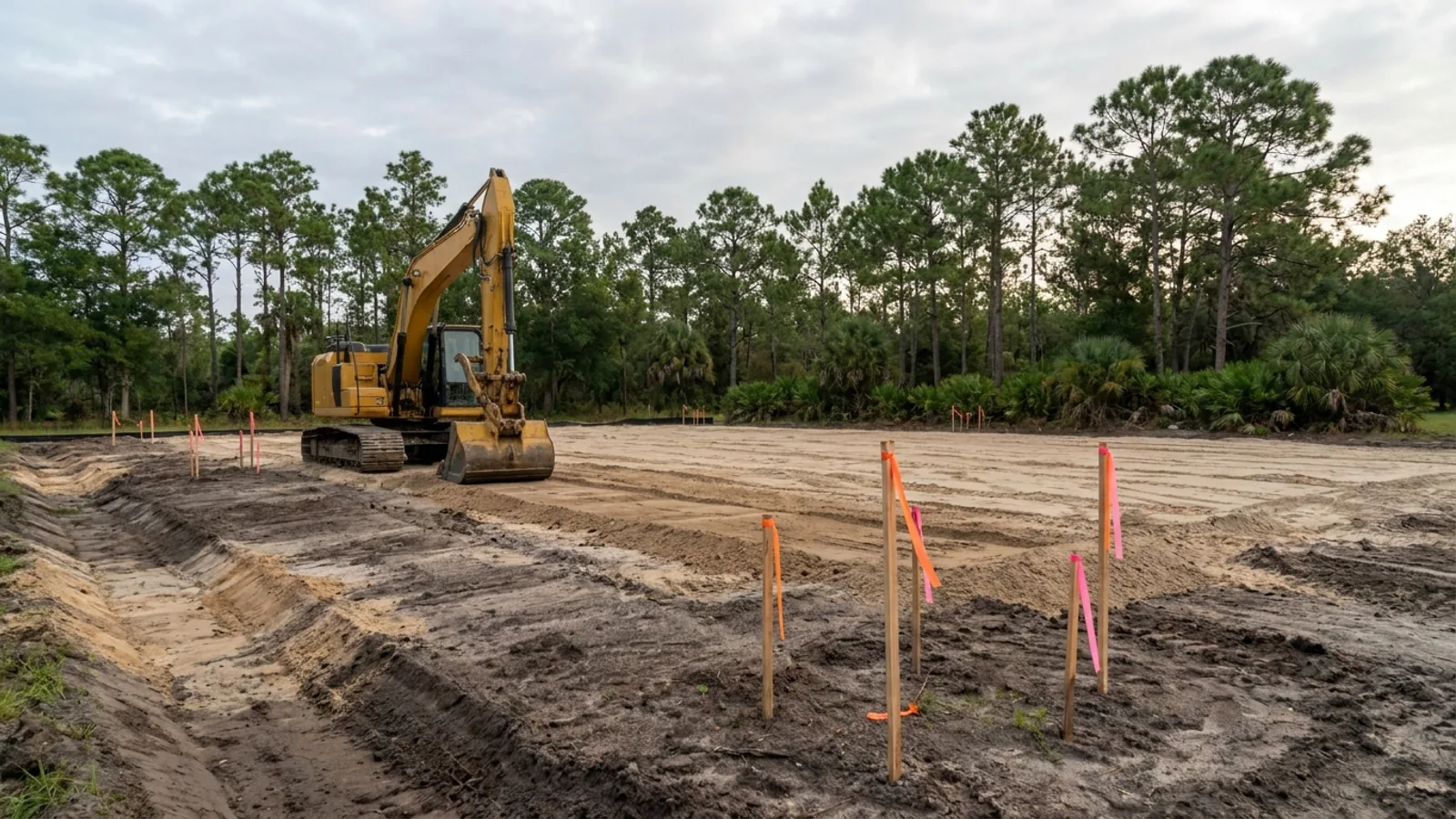
The expensive surprises are in the ground, not the building
Most of Flagler County rates poorly for dwellings in the soil survey, and the reason is water sitting close to the surface rather than weak ground. That makes the pad elevation and the drainage plan the two line items most likely to move your budget. We price the dirt before we price the building.
What we build in Palm Coast
Every service we offer is available across Flagler County, from a shell kit you erect yourself to a finished home we hand you the keys to. What a build costs depends far more on the parcel than on square footage, so we price against your land rather than publishing a rate card.
See all nine servicesWhat a build looks like
Three stages every Palm Coast project passes through, from a raw parcel to a finished home. Site work first, because that is where the budget is decided.
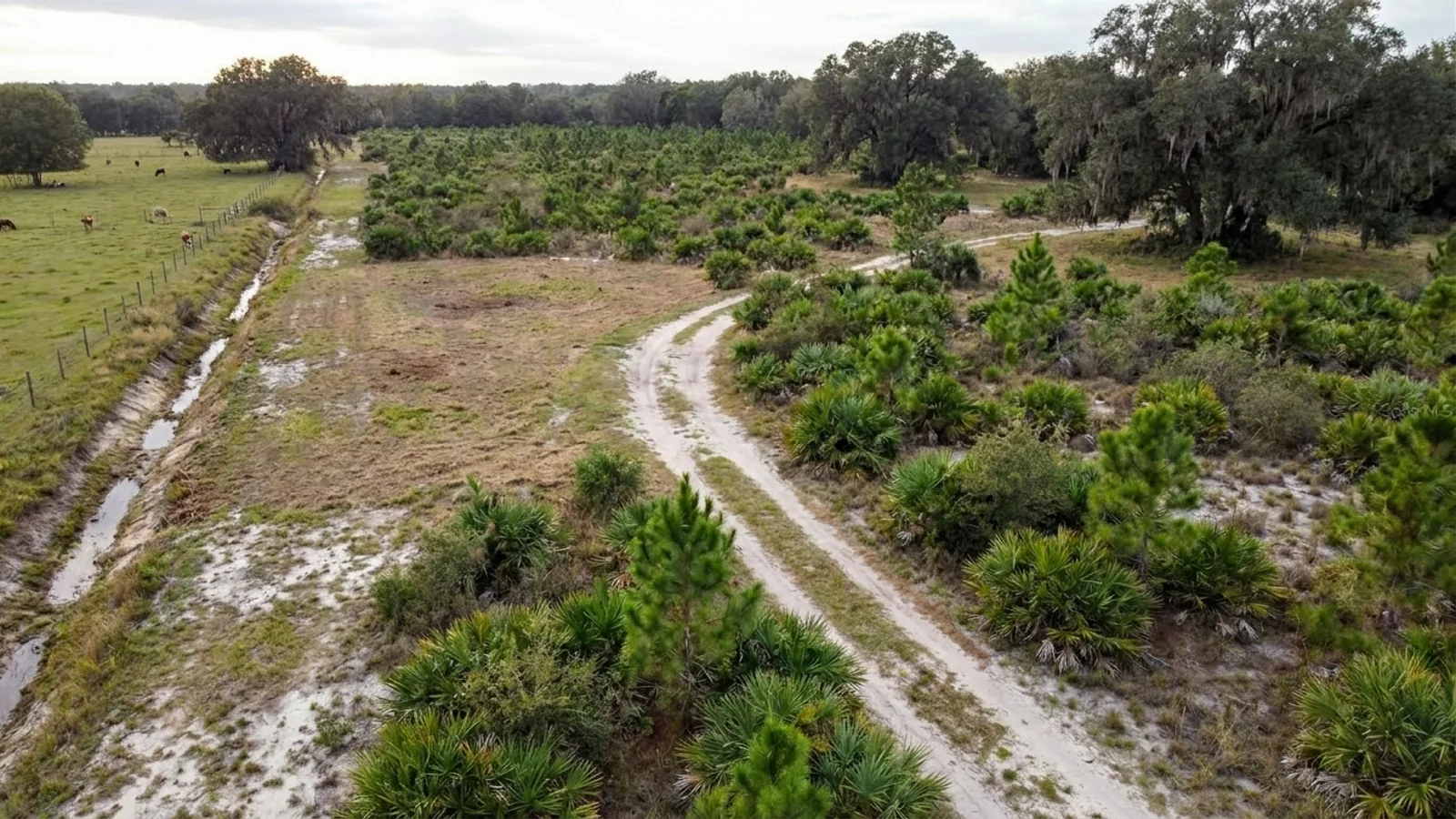
The parcel
Zoning, setbacks, flood zone and utility access get checked before anything is drawn.
Pad and permit
Clearing, grading and a compacted pad, while the submittal works through Flagler County.
Frame to finish
Shell erected and dried in, then systems, insulation and interior finish through to CO.
Those are the rules for Flagler County. Tell us what you want to build and we will draw it to them.
Where we build around Palm Coast
Flagler County and the rural land around it. The buildable acreage for a project this size usually sits outside the city limits, which is frequently what changes who issues your permit.
Keep reading
The questions that usually come next once you know what Palm Coast allows.
Barndominium Cost Guide
Sourced per-square-foot ranges by tier and by size, with a calculator built on the same figures.
Read itIs It Legal in Florida?
Classification, zoning, the HOA gate, and the agricultural exemption that does not cover a home.
Read itHow Long Does It Take?
Census build-duration data, and the Florida statute capping permit review at 30 business days.
Read itSources for this page
The primary documents behind the Palm Coast figures above. We would rather you checked them than took our word for it.
- Flagler County Code of OrdinancesZoning districts, minimum lot sizes, setbacks and height limits, as adopted.library.municode.com
- Florida Statute 553.792The 30-business-day permit review clock, and the 10% fee reduction per day a jurisdiction runs late.flsenate.gov
- Florida Building CodeThe adopted code itself, including the wind-speed figures and the High Velocity Hurricane Zone definition.floridabuilding.org
- ASCE 7 Hazard ToolLook up the ultimate design wind speed at a specific address rather than reading it off a contour map.asce7hazardtool.online
- Florida Statute 604.50The nonresidential farm building exemption, and its explicit carve-out of residential dwellings.flsenate.gov
Nearby areas we build in
Close to Palm Coast, though the permitting authority and wind requirements can differ once you cross a county line.
Building in Palm Coast: common questions
11 questions we get asked most often about building in Palm Coast. If yours is not on the list, ask it directly.
Should I build inside Palm Coast, or out in unincorporated Flagler County?
How much land do I need, and what zoning applies?
What wind speed does my building have to be engineered to?
Who issues my permit, the city or the county?
What's the story with Flagler County's impact fee moratorium?
What do impact fees add up to if I build inside Palm Coast?
Is Palm Coast in the High Velocity Hurricane Zone?
Do I need impact windows here?
What about flood insurance discounts?
What's driving the growth in Flagler County, and how does it affect land availability?
Can I use the agricultural exemption to skip permitting on my barn?
Building in Palm Coast?
Start with the plan. Tell us what you want to build and we will draw it, then confirm what Flagler County will actually let you put on the parcel and what wind load it has to meet. That conversation costs nothing.