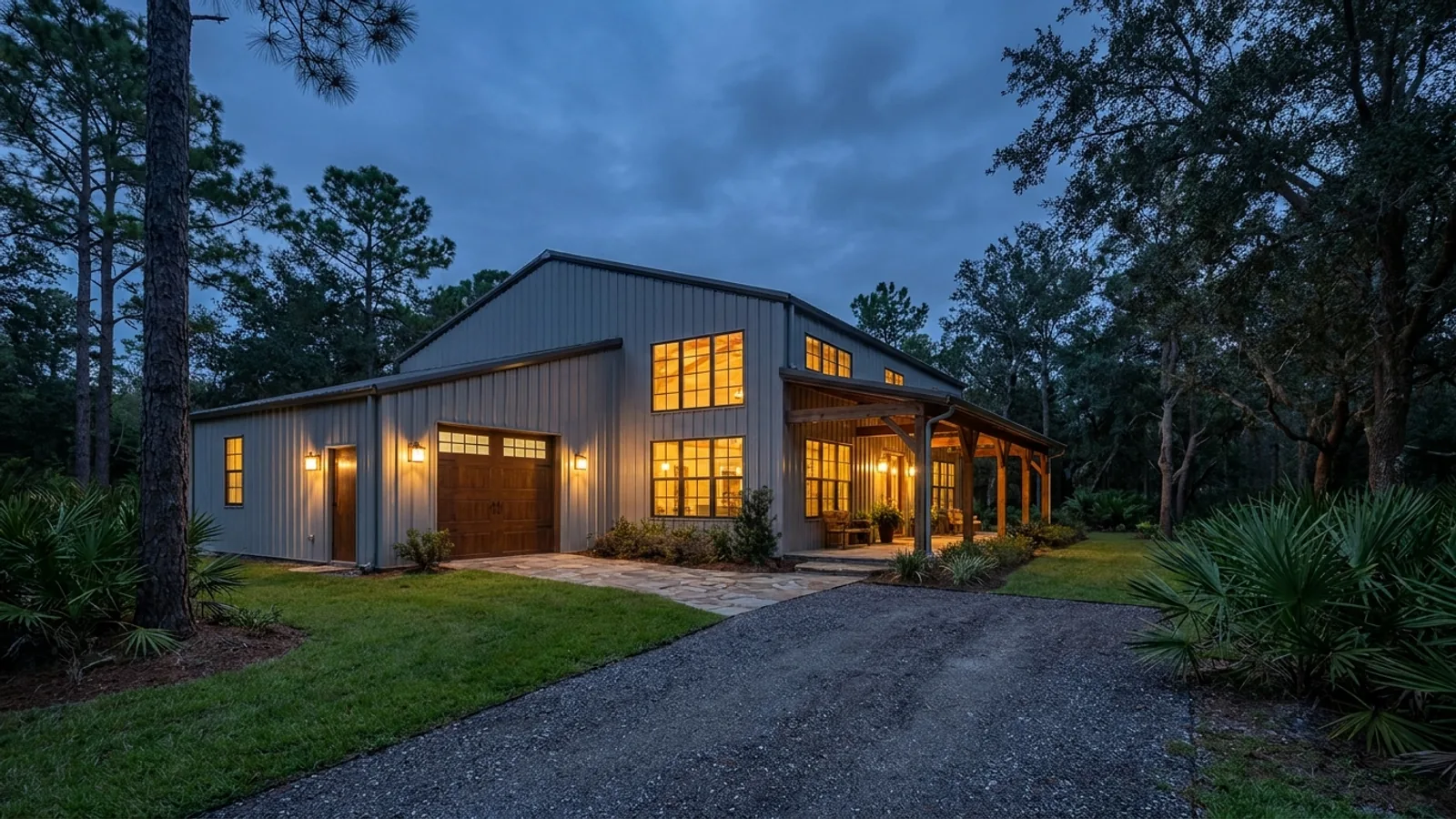
Barndominium Builders in Tallahassee, FL
Leon County has the lowest design wind speed of anywhere we build, no impact glazing requirement, no impact fees at all, and a rural district that places no cap whatsoever on how large a shop can be relative to the house. What it does have is trees, a karst plain across the south of the county, and no flood insurance discount. The constraints here are about the land, not the building.
Building conditions in Tallahassee
What actually changes from one Florida city to the next: who issues the permit, what wind speed the structure has to be engineered to, and what the ground is like. These are the numbers your drawings have to satisfy.
Leon County Code section 10-6.802. Adjoining districts cap accessory buildings at twice the principal structure, which is still generous by Florida standards.
FBC 8th Edition (2023) Figure 1609.3(1). Leon accepted the state map as drawn. 120 mph is the conservative value most plan sets carry.
Comparison of FBC 2020 and FBC 2023 contour geometry: movement across Leon County is under 2 km, and the 120 mph line actually shifted marginally seaward.
Leon County Affordable Housing Advisory Committee report, 2025: "Leon County does not impose impact fees. Impact fees were eliminated in 1995."
Leon County DSEM 850-606-1300; City Growth Management 850-891-7001. Assuming there is one shared code is the most common local mistake and it sends people to the wrong desk.
FEMA CRS eligible communities list, effective 1 April 2026: both appear with blank class and discount fields.
Also worth knowing before you build in Tallahassee
- No impact glazing required
- Leon County is landlocked, with Wakulla County between it and the Gulf, and its design wind speed stays below every wind-borne debris trigger. No opening protection is required by code.
- Ten acres in the Rural district
- Low-density residential in the Rural district needs a ten acre minimum lot, with 30 ft front, 20 ft side and 50 ft rear setbacks, 35 ft height and 30% maximum impervious surface. Urban Fringe drops to three acres.
- Trees are the real site-prep variable
- You may clear trees under 36 inches yourself on a rural parcel, but any live oak or longleaf pine over 12 inches is protected, and anything within a canopy road corridor needs Commission approval. That distinction drives site cost more than acreage does.
- Private provider saves 60%
- Use a private provider for plan review or inspections and the county charges only 40% of that fee. It keeps a share because it still has to process the permit, verify insurance and issue the certificate of occupancy.
- The soil test is mandatory
- A soil test signed by a Florida engineer is one of sixteen required submittals on the county single-family checklist, alongside a sealed wind load analysis and flood letter. A geotechnical report is not optional here.
- The clay here does not swell
- North Florida red clay looks like trouble and mostly is not. These are kaolinitic soils with low linear extensibility, and shrink-swell is flagged on only 1.6% of the county. Expansive clay is a Gulf coast problem, not a Tallahassee one.
- The best ground of any market we build in
- 56% of Leon County rates Not Limited for dwellings, against 28% in Polk, 21% in Orange and 7% in Lee. Where there is a constraint it is a high water table, the same as everywhere else in Florida.
- Slope, which is unusual for Florida
- Around 7,000 acres carry slopes of 8% or more, effectively unknown in the peninsula. It affects cut and fill, erosion control and driveway cost. The north of the county rolls; the south is flat.
- Sinkholes: it depends which half
- The Woodville Karst Plain across southern Leon sits in the highest sinkhole favourability class the state model has. The northern Red Hills do not. Leon ranks about 11th of 67 counties for reported subsidence, ahead of Pinellas.
- Tree fall, not wind, is what damages houses here
- Hermine was a Category 1 with 47 mph measured sustained wind, and it took out power for 65% of the city, 75,000 customers, for days. Heavy canopy plus overhead lines is the local failure mode.
- Rainfall, and when to pour
- 59.23 inches a year, with 22 of them falling in June, July and August alone. That is 38% of the year in three months. April and October are the dry windows for slab and dry-in work.
- Measured hurricane wind
- The strongest sustained wind ever recorded at the airport across Hermine, Michael and Idalia is 47 mph, with a 71 mph gust during Michael. The design standard is 120 mph.
FBC 1609.2 definitions. Also outside the HVHZ, which is Broward and Miami-Dade only.
Leon County Code sections 10-6.612 and 10-6.613.
Leon County Code section 10-4.362. Seventy-six miles of designated canopy roads carry protection extending from the centerline.
Leon County fee schedule effective 1 June 2022, following a code amendment in January 2021. Base residential permit is 31 cents per square foot under roof.
Leon County DSEM single-family permit checklist.
USDA NRCS survey FL073. Orangeburg and Faceville, the dominant upland series, measure 1.5 and 1.9 on linear extensibility. Depth to bedrock is not a constraint anywhere in the county.
USDA NRCS survey FL073, our aggregation.
USDA NRCS survey FL073. Leon is a bimodal county: Tallahassee Hills to the north, coastal lowlands and karst plain to the south.
Florida Geological Survey favourability model and subsidence reports: 155 reports, 7 verified as true sinkholes. Land south of Capital Circle deserves ground-penetrating radar screening.
NOAA NHC report on Hermine, 2016. The joint local mitigation strategy names the same mechanism explicitly.
NOAA NCEI 1991-2020 Climate Normals, Tallahassee Regional. Wetter than any peninsular metro, though Pensacola and Niceville are wetter still.
NOAA NHC tropical cyclone reports. Note the Idalia report table misaligns and appears to show 63 kt for Tallahassee; that figure belongs to Horseshoe Beach.
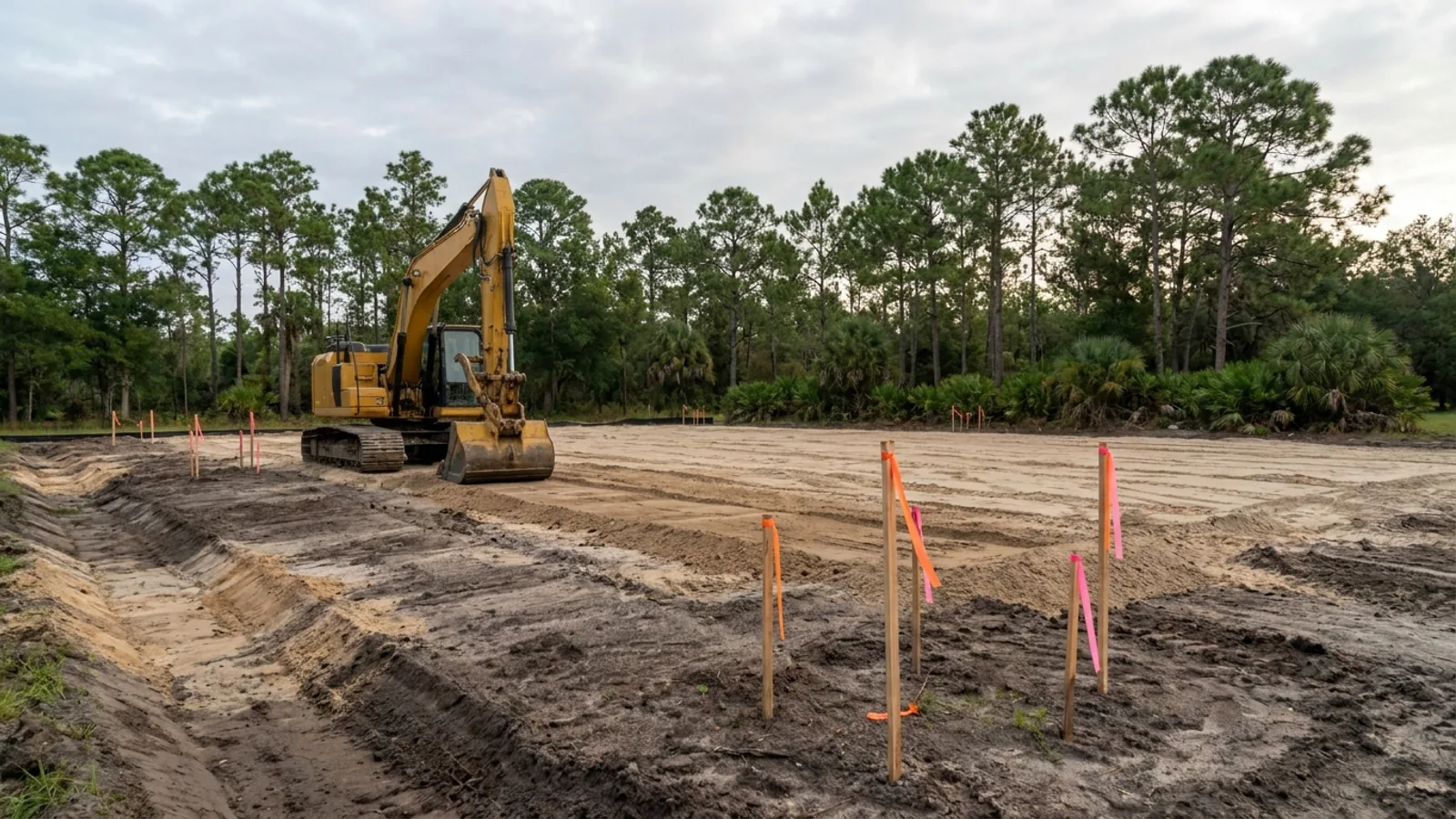
The expensive surprises are in the ground, not the building
Most of Leon County rates poorly for dwellings in the soil survey, and the reason is water sitting close to the surface rather than weak ground. That makes the pad elevation and the drainage plan the two line items most likely to move your budget. We price the dirt before we price the building.
What we build in Tallahassee
Every service we offer is available across Leon County, from a shell kit you erect yourself to a finished home we hand you the keys to. What a build costs depends far more on the parcel than on square footage, so we price against your land rather than publishing a rate card.
See all nine servicesWhat a build looks like
Three stages every Tallahassee project passes through, from a raw parcel to a finished home. Site work first, because that is where the budget is decided.
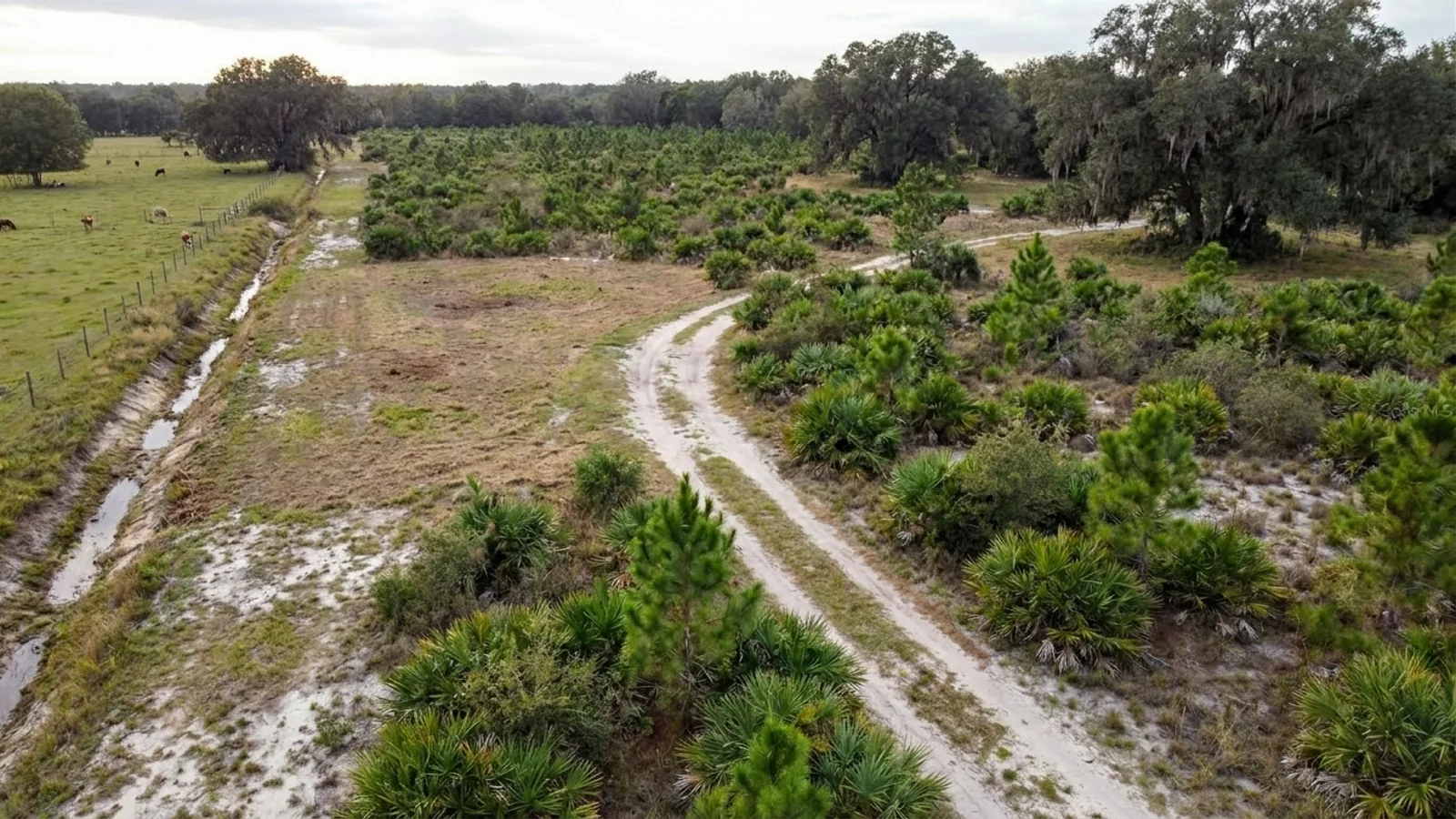
The parcel
Zoning, setbacks, flood zone and utility access get checked before anything is drawn.
Pad and permit
Clearing, grading and a compacted pad, while the submittal works through Leon County.
Frame to finish
Shell erected and dried in, then systems, insulation and interior finish through to CO.
Those are the rules for Leon County. Tell us what you want to build and we will draw it to them.
Where we build around Tallahassee
Leon County and the rural land around it. The buildable acreage for a project this size usually sits outside the city limits, which is frequently what changes who issues your permit.
Keep reading
The questions that usually come next once you know what Tallahassee allows.
Barndominium Cost Guide
Sourced per-square-foot ranges by tier and by size, with a calculator built on the same figures.
Read itIs It Legal in Florida?
Classification, zoning, the HOA gate, and the agricultural exemption that does not cover a home.
Read itHow Long Does It Take?
Census build-duration data, and the Florida statute capping permit review at 30 business days.
Read itSources for this page
The primary documents behind the Tallahassee figures above. We would rather you checked them than took our word for it.
- Leon County Code of OrdinancesZoning districts, minimum lot sizes, setbacks and height limits, as adopted.library.municode.com
- Leon County Building DepartmentThe authority that reviews and issues the permit for unincorporated parcels.cms.leoncountyfl.gov
- Florida Statute 553.792The 30-business-day permit review clock, and the 10% fee reduction per day a jurisdiction runs late.flsenate.gov
- Florida Building CodeThe adopted code itself, including the wind-speed figures and the High Velocity Hurricane Zone definition.floridabuilding.org
- ASCE 7 Hazard ToolLook up the ultimate design wind speed at a specific address rather than reading it off a contour map.asce7hazardtool.online
Nearby areas we build in
Close to Tallahassee, though the permitting authority and wind requirements can differ once you cross a county line.
Building in Tallahassee: common questions
8 questions we get asked most often about building in Tallahassee. If yours is not on the list, ask it directly.
How big can the shop be compared to the house?
I heard the 2023 code raised wind speeds in the panhandle. Does that affect me?
What does it cost in fees to build in Leon County?
Do I need impact windows in Tallahassee?
Is north Florida clay going to be a problem for my slab?
Can I clear my own land?
Should I worry about sinkholes in Leon County?
What actually damages houses here in a hurricane?
Building in Tallahassee?
Start with the plan. Tell us what you want to build and we will draw it, then confirm what Leon County will actually let you put on the parcel and what wind load it has to meet. That conversation costs nothing.