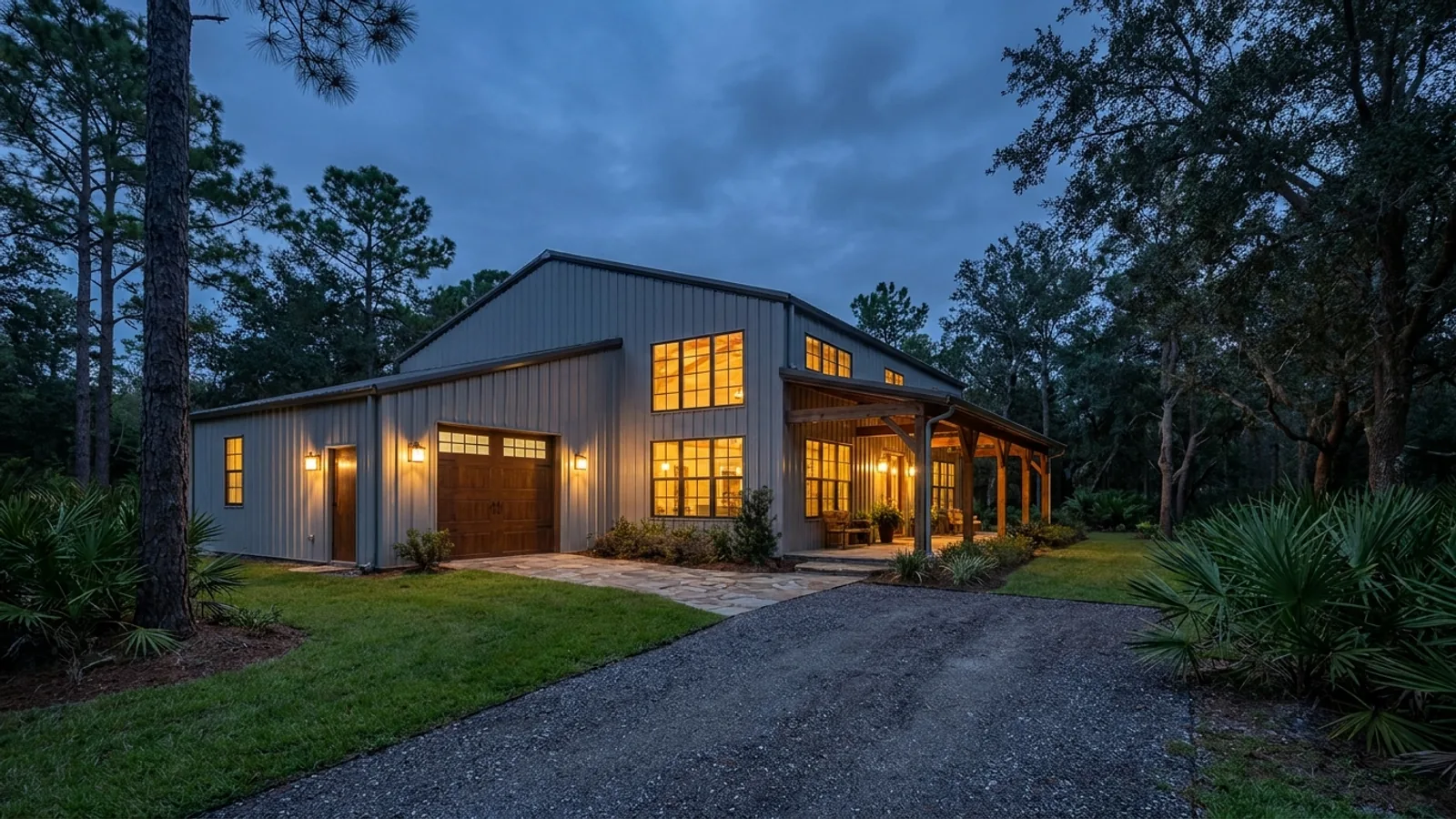
Barndominium Builders in St. Petersburg, FL
St. Petersburg sits inside Florida's most densely populated county, and the honest answer to "how much land do I need" is: not much. Only 18 parcels in all of Pinellas County still carry an agricultural land-use classification, out of roughly 280,000 parcels total, so if acreage is what you want, our Ocala or inland Central Florida pages are the better fit. If you're building on a standard St. Petersburg lot, here's what actually governs that project: a 145 mph design wind speed, impact-rated glazing required on every opening countywide, and a permitting desk that belongs to the city, not the county, for most Pinellas addresses. Pinellas' population is now declining, driven in part by the back-to-back 2024 hurricanes, which is exactly the case for building the replacement home or shop-house to a higher standard than what it's replacing.
St. Petersburg at a glance
- County
- Pinellas County
- Population
- 948,563
- Also serving in Pinellas County
- Clearwater
Building conditions in St. Petersburg
What actually changes from one Florida city to the next: who issues the permit, what wind speed the structure has to be engineered to, and what the ground is like. These are the numbers your drawings have to satisfy.
Pinellas County Property Appraiser, 2021 Final Land Use Recap (pcpao.gov). The parcel count is consistent with the county's own near-buildout planning language.
Pinellas County Construction Licensing Board (PCCLB), Local Technical Amendment to FBC §1609.3, 2023 (8th Edition) cycle, pcclb.com/pdf/lta/2023/building_1609.3.pdf.
City of St. Petersburg Construction Services & Permitting Division, One 4th Street North, St. Petersburg FL 33701, 727-893-7231 (portal: actiononline.stpete.org); Pinellas County Building & Development Review Services, 727-464-3888; Pinellas County 'Unincorporated Areas' page (pinellas.gov/unincorporated-areas).
Pinellas County CRS page (pinellas.gov). St. Petersburg's Class 5 rating is drawn from flood-insurance industry sources citing the city's CRS participation. CRS classes are reassessed roughly annually, so we confirm the current class against FEMA's CRS Communities list before finalizing a client's insurance estimate.
National Hurricane Center Tropical Cyclone Report, Hurricane Milton (AL142024), nhc.noaa.gov/data/tcr/AL142024_Milton.pdf.
U.S. Census Bureau Vintage 2025 county population estimates, press release 26 March 2026 (census.gov/newsroom/press-releases/2026/2025-popest-metro-micro-counties.html), reported by WUSF, Fox13, and Bay News 9.
Also worth knowing before you build in St. Petersburg
- Impact windows aren't just for waterfront lots
- The entire county sits in the wind-borne debris region, not just a strip near the coast. Because Pinellas' 145 mph design wind speed already clears the 140 mph statewide trigger on its own, every opening on every parcel needs impact-rated glazing or shutters, coastal or inland. Same pattern we've confirmed in Lee County (Cape Coral) and all of Broward.
- The old agricultural zoning district is a legal relic, not a market
- Unincorporated Pinellas still has an A-E (Agricultural Estate Residential) zoning district on the books, with a 2-acre minimum lot. Almost nothing in the county actually uses it that way anymore, see the 18-parcel figure above. Any 2-acre A-E lot you find is more likely a legacy estate parcel than working farmland, and there are very few of them left.
- Florida's most densely populated county
- 274 square miles of land (the rest of the county's 608 sq mi total is Tampa Bay and the Gulf), holding roughly 950,000 people, about 3,500 people per square mile of land. The county's own planning documentation describes Pinellas as near-buildout, with what vacant land remains characterized as small, scattered, irregular parcels rather than any large contiguous tract.
- Multimodal impact fee
- The county's tiered Schedule A single-family rate runs $1,356 for a home under 1,500 sq ft, $1,679 from 1,501-2,499 sq ft, and $2,066 at 2,500 sq ft and up.
- Building permit fee schedule
- Pinellas County's unincorporated-area building permit fee runs roughly $9 per $1,000 of valuation under $1 million (with a $100 minimum), dropping to $8 per $1,000 above $1 million. St. Petersburg issues permits under its own fee schedule; we confirm the current city rate with Construction Services & Permitting before finalizing a project budget.
- Ground conditions
- Pinellas soils are typical Florida flatwoods: predominantly poorly-to-somewhat-poorly drained sand with a shallow seasonal high water table, commonly 10-40 inches below the surface depending on the map unit and season. Foundation design, commonly slab-on-grade with engineered fill, or raised, needs to account for that site-by-site.
- Outside the High Velocity Hurricane Zone
- Only Miami-Dade and Broward counties are the HVHZ. Pinellas is outside it, and its 145 mph design wind speed is a meaningfully less exotic code regime than what those two counties require.
- Permit review deadline
- 30 business days for a single-family home, or the jurisdiction has to cut the permit fee by 10% per business day it runs late. Applies in St. Petersburg and unincorporated Pinellas exactly as it does statewide, no local carve-out found.
- St. Petersburg's ADU ordinance fits the shop-house angle
- St. Petersburg has an active accessory dwelling unit ordinance, relevant if you're thinking about a shop-plus-living-quarters build on a standard city lot rather than a standalone barn. We confirm the specific size and setback rules with the city's Construction Services & Permitting Division as part of feasibility.
FBC §1609.2/§1609.1.2 wind-borne debris region triggers, applied to the PCCLB's confirmed 145 mph Risk Category II design wind speed.
Pinellas County Code of Ordinances, Chapter 138, Article IV (A-E district); Pinellas County Zoning District Summary Guide (pinellas.gov).
U.S. Census Bureau QuickFacts; Pinellas County Planning Department comprehensive plan materials (plan.pinellas.gov).
Pinellas County Code of Ordinances, Chapter 150 (Impact Fees), Article II §150-40. We confirm the current rate with St. Petersburg Construction Services (727-893-7231) or Pinellas BDRS before finalizing a client's budget.
City of St. Petersburg fee schedule PDF (cms5.revize.com), dated November 2017; unincorporated county figure per a March 2026 secondary summary. We pull the current St. Petersburg schedule directly from Construction Services & Permitting (727-893-7231) before quoting a number.
USDA-NRCS Soil Survey of Pinellas County, Florida (certified/tabular data dated 2 October 2017 per NRCS Web Soil Survey). Series named include Myakka, Immokalee, EauGallie, Pompano, Adamsville, Astatula, Oldsmar, Wauchula, Wabasso, and Terra Ceia.
Florida Building Code 8th Edition (2023), Section 202 definitions.
F.S. 553.792, as amended by HB 267 (2024), effective 1 January 2025; F.S. 553.791 (private provider route) applies the same way.
City of St. Petersburg, stpete.org/residents/housing/homeowners/accessory_dwelling_units.php.
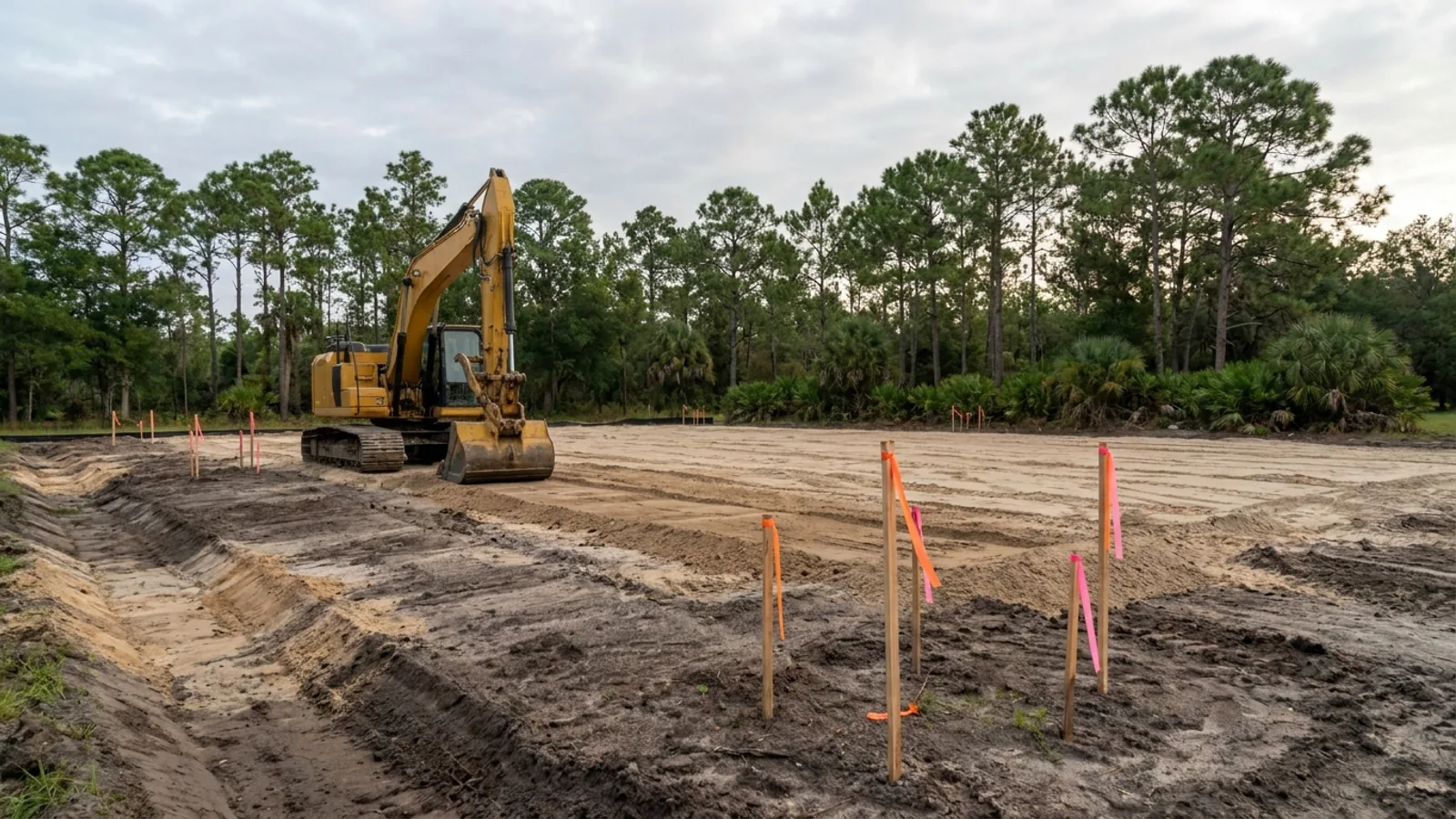
The expensive surprises are in the ground, not the building
Most of Pinellas County rates poorly for dwellings in the soil survey, and the reason is water sitting close to the surface rather than weak ground. That makes the pad elevation and the drainage plan the two line items most likely to move your budget. We price the dirt before we price the building.
What we build in St. Petersburg
Every service we offer is available across Pinellas County, from a shell kit you erect yourself to a finished home we hand you the keys to. What a build costs depends far more on the parcel than on square footage, so we price against your land rather than publishing a rate card.
See all nine servicesWhat a build looks like
Three stages every St. Petersburg project passes through, from a raw parcel to a finished home. Site work first, because that is where the budget is decided.
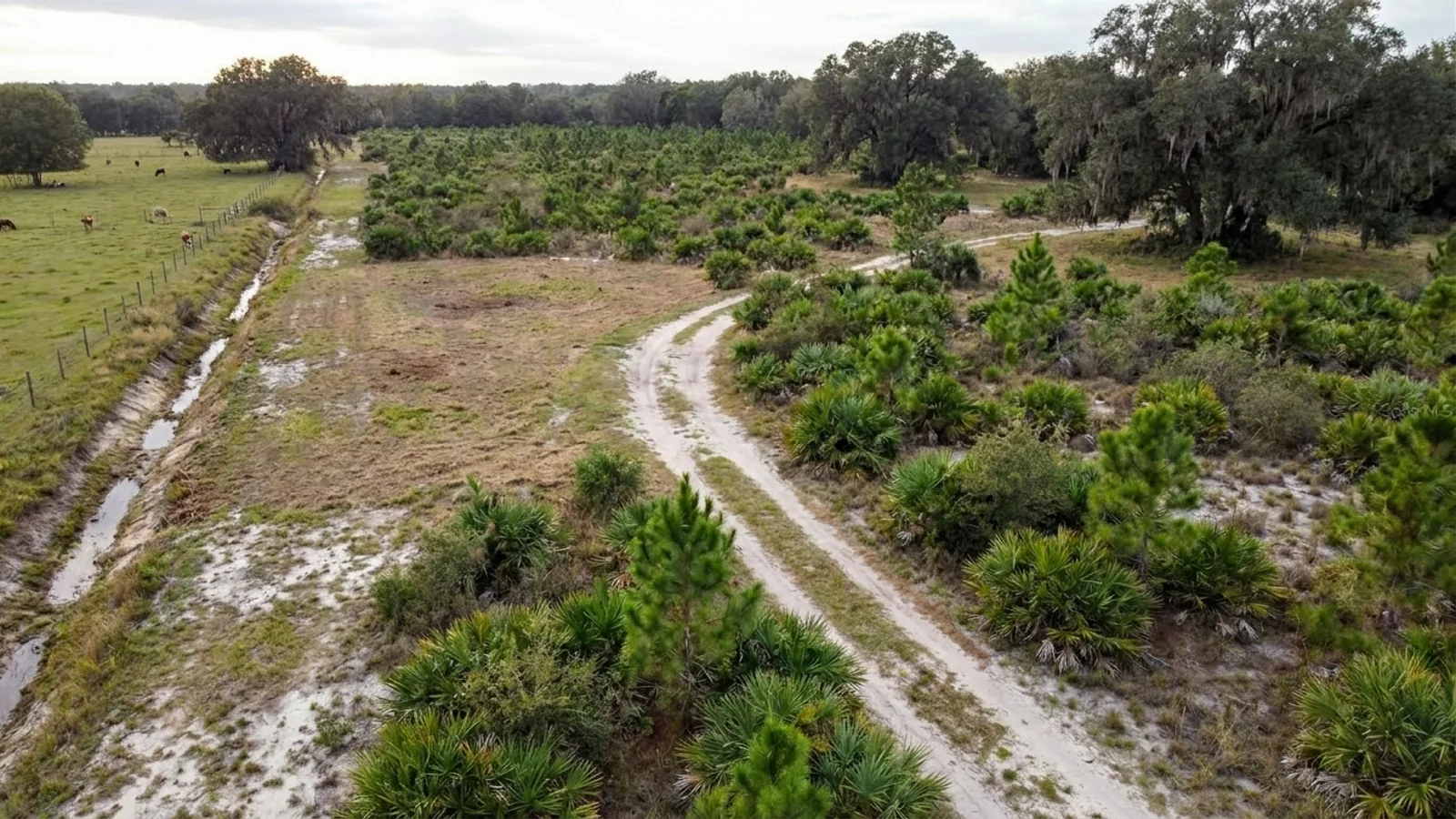
The parcel
Zoning, setbacks, flood zone and utility access get checked before anything is drawn.
Pad and permit
Clearing, grading and a compacted pad, while the submittal works through Pinellas County.
Frame to finish
Shell erected and dried in, then systems, insulation and interior finish through to CO.
Those are the rules for Pinellas County. Tell us what you want to build and we will draw it to them.
Where we build around St. Petersburg
Pinellas County and the rural land around it. The buildable acreage for a project this size usually sits outside the city limits, which is frequently what changes who issues your permit.
Keep reading
The questions that usually come next once you know what St. Petersburg allows.
Barndominium Cost Guide
Sourced per-square-foot ranges by tier and by size, with a calculator built on the same figures.
Read itIs It Legal in Florida?
Classification, zoning, the HOA gate, and the agricultural exemption that does not cover a home.
Read itHow Long Does It Take?
Census build-duration data, and the Florida statute capping permit review at 30 business days.
Read itSources for this page
The primary documents behind the St. Petersburg figures above. We would rather you checked them than took our word for it.
- Pinellas County Code of OrdinancesZoning districts, minimum lot sizes, setbacks and height limits, as adopted.library.municode.com
- Pinellas County Building DepartmentThe authority that reviews and issues the permit for unincorporated parcels.pinellas.gov
- Florida Statute 553.792The 30-business-day permit review clock, and the 10% fee reduction per day a jurisdiction runs late.flsenate.gov
- Florida Building CodeThe adopted code itself, including the wind-speed figures and the High Velocity Hurricane Zone definition.floridabuilding.org
- ASCE 7 Hazard ToolLook up the ultimate design wind speed at a specific address rather than reading it off a contour map.asce7hazardtool.online
Nearby areas we build in
Close to St. Petersburg, though the permitting authority and wind requirements can differ once you cross a county line.
Building in St. Petersburg: common questions
10 questions we get asked most often about building in St. Petersburg. If yours is not on the list, ask it directly.
Can I build a barndominium on acreage in St. Petersburg?
What wind speed does my building have to be engineered to?
Do I need impact windows if I'm not right on the water?
Who issues my permit, the city or the county?
What's my flood insurance situation in St. Petersburg?
How bad was Hurricane Milton here?
Should I be worried about the population decline in Pinellas County?
What do impact fees add up to?
What's the ground like in St. Petersburg?
Can I put a shop or ADU on my lot instead of a standalone barn?
Building in St. Petersburg?
Start with the plan. Tell us what you want to build and we will draw it, then confirm what Pinellas County will actually let you put on the parcel and what wind load it has to meet. That conversation costs nothing.