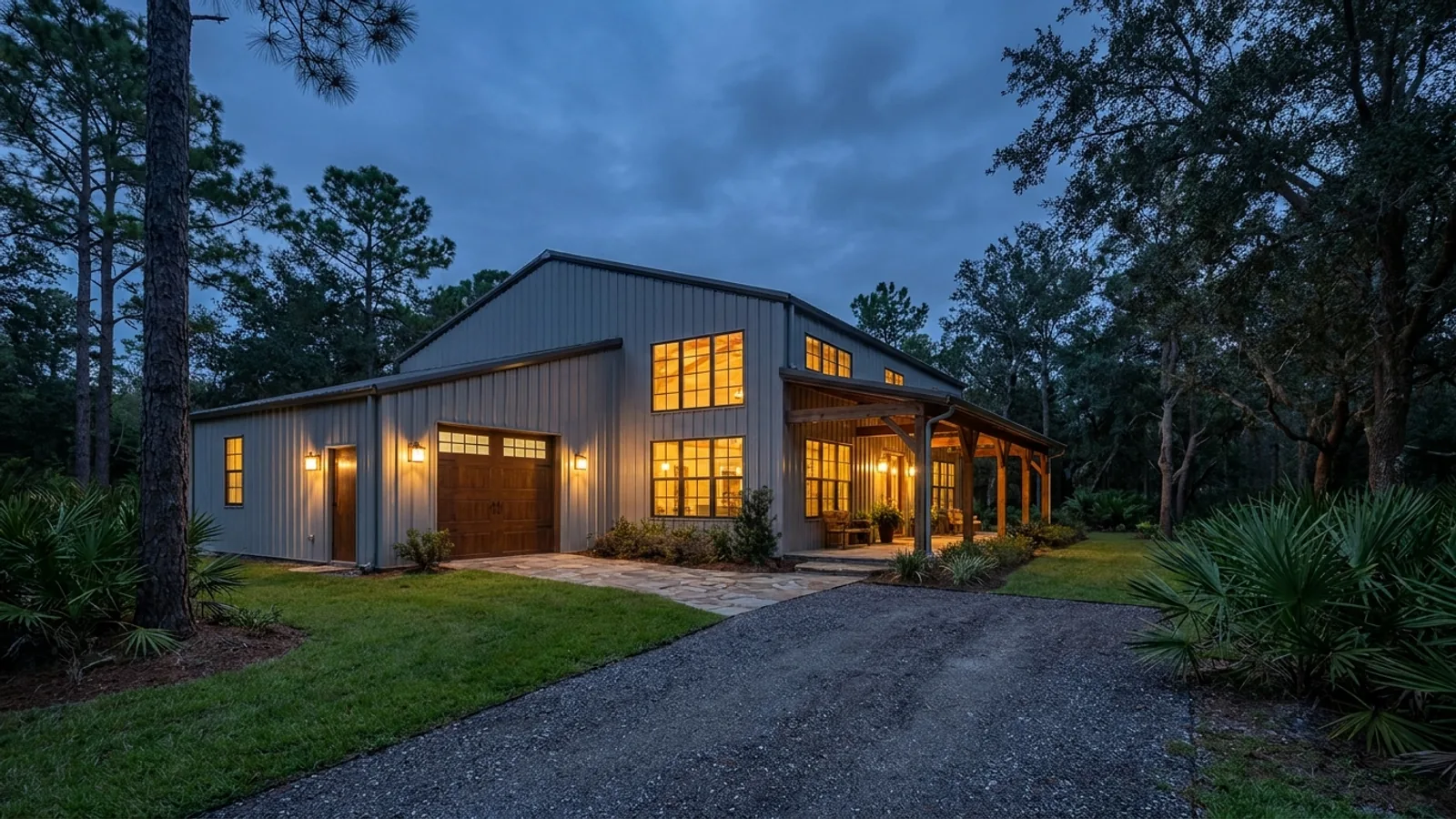
Barndominium Builders in Orlando, FL
Most barndominium land around Orlando is not in Orlando. Roughly 88 percent of Orange County lies outside the city limits, which changes who issues your permit, what it costs, and which zoning table applies. Orange County is also one of the easier places in Florida to build this way: outside the High Velocity Hurricane Zone, outside the wind-borne debris region, and sitting on a half-acre minimum lot in the agricultural districts.
Building conditions in Orlando
What actually changes from one Florida city to the next: who issues the permit, what wind speed the structure has to be engineered to, and what the ground is like. These are the numbers your drawings have to satisfy.
F.S. 553.80 (2024 Florida Statutes); Orange County Zoning Division; land areas from US Census 2024 Gazetteer (903.0 sq mi county, 111.1 sq mi city).
F.S. 553.792, as amended by HB 267 (2024), effective 1 January 2025. Orange County publishes no turnaround time of its own.
Florida Building Code 8th Edition (2023), Figure 1609.3(1), adopting ASCE 7-22. Site-specific values from the ASCE 7 Hazard Tool.
Orange County Code § 38-1501, last amended Ord. No. 2016-19 (13 September 2016).
F.S. 604.50, which defines a nonresidential farm building as one not intended to be used as a residential dwelling. Parallel exemption at F.S. 553.73(10)(c).
Orange County impact fee schedule: transportation effective 1 January 2026, fire/law/parks effective 1 May 2026, school effective 1 October 2022.
Also worth knowing before you build in Orlando
- Faster route: private provider
- Hire a private provider for plan review and the building official has 20 business days, or 10 if the provider is a sealing engineer or architect. The jurisdiction must reduce your fee by its cost saving.
- High Velocity Hurricane Zone
- Outside it. The HVHZ is Broward and Miami-Dade counties only, so Orange County builds avoid that entire additional approval regime.
- Wind-borne debris region
- Outside it. Impact-rated glazing is not required by code on a typical Orange County residence, which is a real cost difference against coastal Florida. Insurers and HOAs may still ask for it.
- Setback from water
- Any principal structure must sit at least 50 ft back from the normal high water contour of an adjacent surface water body. In a county this full of lakes it is a genuine siting constraint.
- Ground conditions
- 55.4% of the county rates Very Limited for dwellings. The constraint is a water table 45 to 75 cm below surface, not weak ground: shrink-swell soils cover only 14,000 of 642,200 acres. This is a drainage and slab-elevation problem, not a bearing problem.
- Sinkhole risk is low here
- 72.2% of Orange County rates Least Favorable for sinkhole formation, and the county ranks 7th statewide for subsidence reports with 3 verified sinkholes on record. Northwest Orange, toward Apopka, is the exception.
- Termite protection is mandatory
- All of Florida is Termite Infestation Probability Zone 1, Very Heavy. Florida requires registered termiticide treatment plus a Certificate of Compliance on every new dwelling regardless of framing material. Steel framing does not exempt you.
- Steel framing submittal requirement
- Plans must show size of steel members, material grade, weld grade, and connection details. This is the requirement most out-of-state kit drawings fail on.
- Building permit fee
- Unincorporated Orange County charges $26 for the first $1,000 of valuation plus $3 per additional $1,000. Inside Orlando city limits it is $64.94 plus $4.32 per $1,000, roughly two and a half times the county rate.
- Rainfall and drainage
- 51.45 inches a year, with about 45% of it falling in June, July and August. Site drainage gets designed around the wet season, not the annual average.
- Hurricane exposure, measured
- Hurricane Charley delivered 79 mph sustained winds and a 105 mph gust at Orlando International in 2004, roughly 65 miles inland. No Category 3 or stronger has passed within 50 nautical miles of Orlando in 174 years of record.
- Flood insurance discount
- Orange County holds a Community Rating System Class 5, which earns residents a 25% discount on National Flood Insurance Program premiums.
F.S. 553.791. Acknowledged in the Orange County Fee Directory FY2025-26, p. 27.
Florida Building Code 8th Edition (2023), Section 202 definitions.
Adopted FBC 2023 wind-borne debris region map: Orange County is entirely unshaded. The county is landlocked and under the 140 mph trigger.
Orange County Code § 38-1501, footnote a, with the lakeshore protection ordinance.
USDA NRCS Soil Survey, Orange County survey area FL095. Bearing capacity must come from a site-specific geotechnical report.
Florida Geological Survey Favorable Geology model and Subsidence Incident Reports (1909 to August 2026). Most reports are unverified; reporting is voluntary.
Florida Building Code Residential R318.1 (8th Edition, 2023); HUD TIP Zone map. Steel still avoids the rot and food-source problem, just not the treatment requirement.
Orange County Residential Plan Review Checklist, citing FBC-R R301.1.1(2) and AISI S230.
Orange County Fee Directory FY2025-26 (July 2025); City of Orlando residential fee schedule (January 2023, rev. May 2023). Verify city figures before relying on them.
NOAA NCEI 1991-2020 Climate Normals, Orlando International Airport.
NOAA National Hurricane Center tropical cyclone report for Charley (2004); NOAA HURDAT2 best-track database, 1851 to 2024.
Orange County Floodplain Management. Check your parcel on the FEMA Map Service Center before you design the pad elevation.
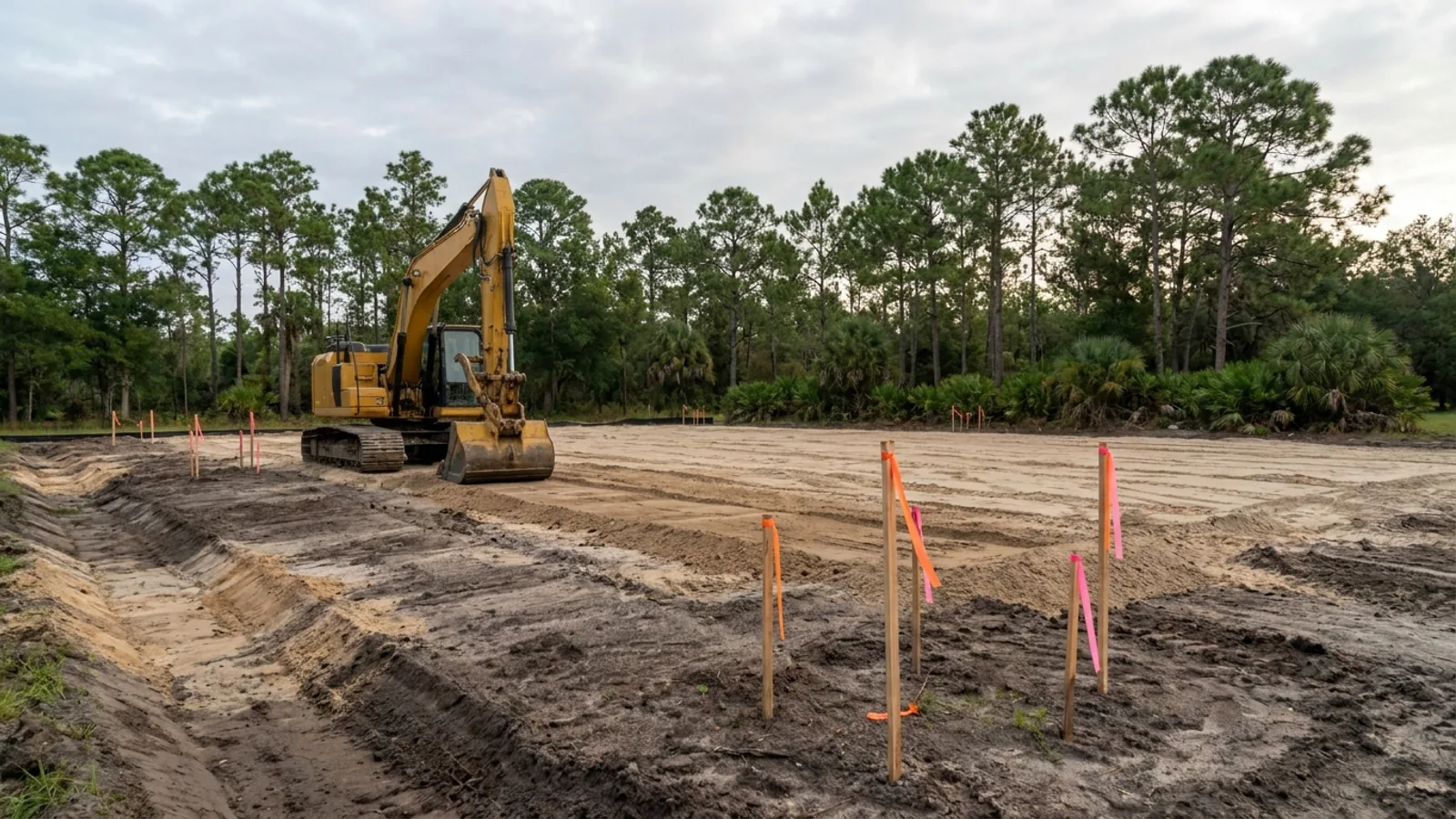
The expensive surprises are in the ground, not the building
Most of Orange County rates poorly for dwellings in the soil survey, and the reason is water sitting close to the surface rather than weak ground. That makes the pad elevation and the drainage plan the two line items most likely to move your budget. We price the dirt before we price the building.
What we build in Orlando
Every service we offer is available across Orange County, from a shell kit you erect yourself to a finished home we hand you the keys to. What a build costs depends far more on the parcel than on square footage, so we price against your land rather than publishing a rate card.
See all nine servicesWhat a build looks like
Three stages every Orlando project passes through, from a raw parcel to a finished home. Site work first, because that is where the budget is decided.
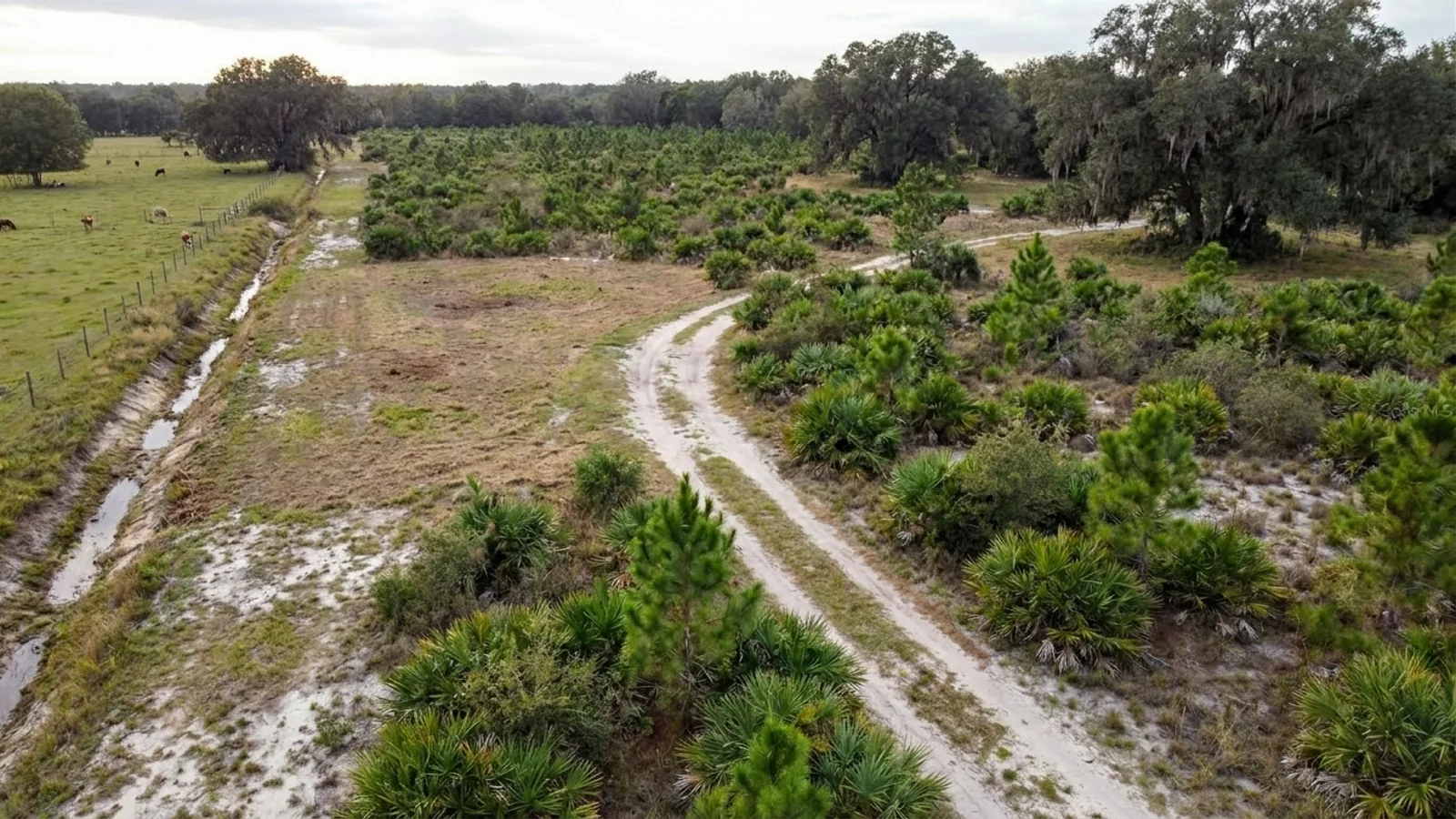
The parcel
Zoning, setbacks, flood zone and utility access get checked before anything is drawn.
Pad and permit
Clearing, grading and a compacted pad, while the submittal works through Orange County.
Frame to finish
Shell erected and dried in, then systems, insulation and interior finish through to CO.
Those are the rules for Orange County. Tell us what you want to build and we will draw it to them.
Where we build around Orlando
Orange County and the rural land around it. The buildable acreage for a project this size usually sits outside the city limits, which is frequently what changes who issues your permit.
Keep reading
The questions that usually come next once you know what Orlando allows.
Barndominium Cost Guide
Sourced per-square-foot ranges by tier and by size, with a calculator built on the same figures.
Read itIs It Legal in Florida?
Classification, zoning, the HOA gate, and the agricultural exemption that does not cover a home.
Read itHow Long Does It Take?
Census build-duration data, and the Florida statute capping permit review at 30 business days.
Read itSources for this page
The primary documents behind the Orlando figures above. We would rather you checked them than took our word for it.
- Orange County Code of OrdinancesZoning districts, minimum lot sizes, setbacks and height limits, as adopted.library.municode.com
- Orange County Building DepartmentThe authority that reviews and issues the permit for unincorporated parcels.orangecountyfl.net
- Florida Statute 553.792The 30-business-day permit review clock, and the 10% fee reduction per day a jurisdiction runs late.flsenate.gov
- Florida Building CodeThe adopted code itself, including the wind-speed figures and the High Velocity Hurricane Zone definition.floridabuilding.org
- ASCE 7 Hazard ToolLook up the ultimate design wind speed at a specific address rather than reading it off a contour map.asce7hazardtool.online
Nearby areas we build in
Close to Orlando, though the permitting authority and wind requirements can differ once you cross a county line.
Building in Orlando: common questions
12 questions we get asked most often about building in Orlando. If yours is not on the list, ask it directly.
Who issues the permit for a barndominium near Orlando?
How long does plan review actually take in Orange County?
What wind speed does my building have to be engineered to?
Do I need impact windows in Orlando?
Is Orlando in the High Velocity Hurricane Zone?
How much land do I need to build a barndominium in Orange County?
Can I use an agricultural exemption to skip permitting?
Will an agricultural classification lower the taxes on my barndominium?
What are the ground conditions like around Orlando?
Should I be worried about sinkholes?
Does a steel frame mean I can skip termite treatment in Orlando?
What do the county fees add up to before I even start building?
Building in Orlando?
Start with the plan. Tell us what you want to build and we will draw it, then confirm what Orange County will actually let you put on the parcel and what wind load it has to meet. That conversation costs nothing.