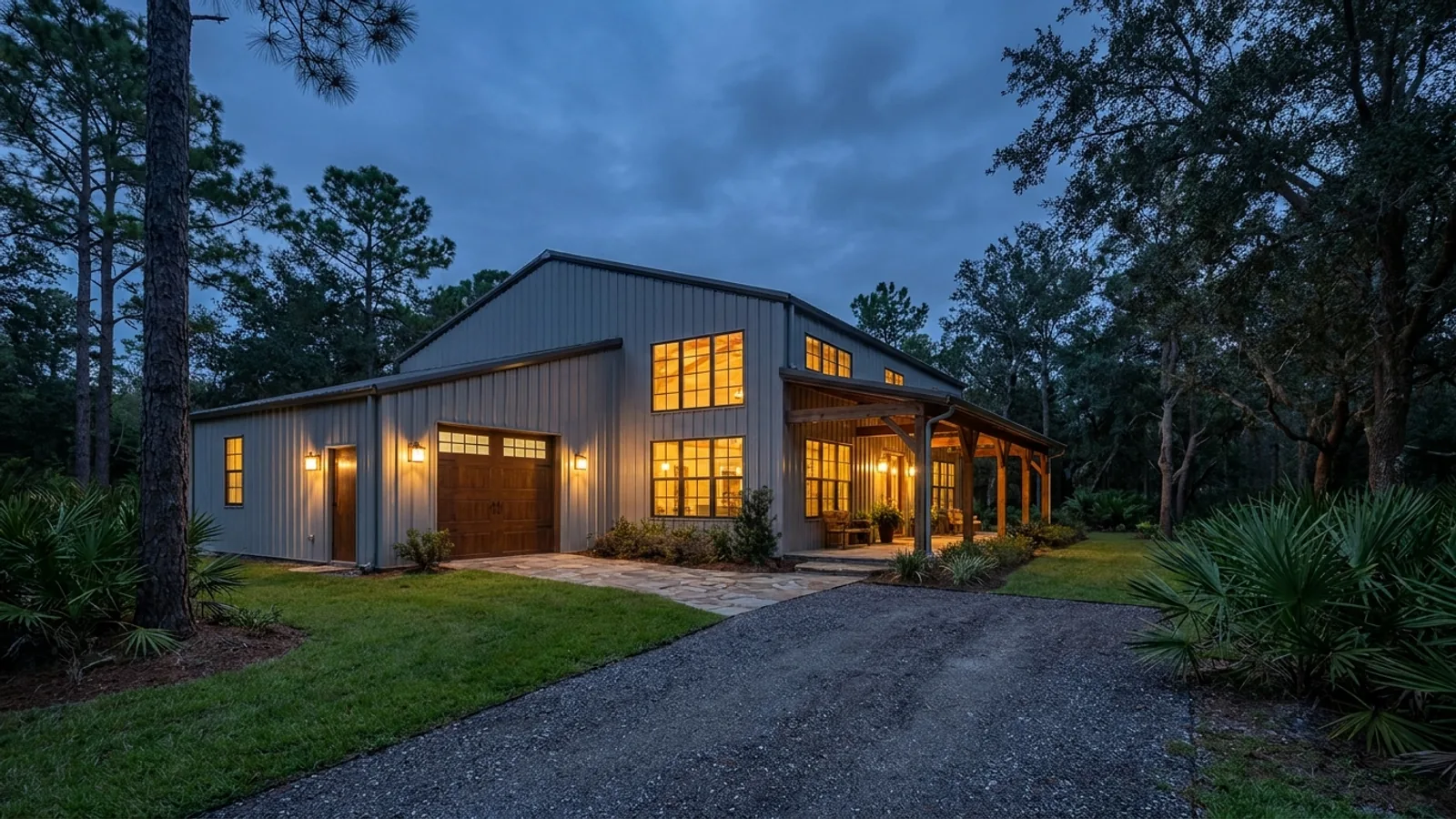
Barndominium Builders in Lakeland, FL
Polk County is about as friendly to this kind of build as Florida gets. Around 85 percent of it is unincorporated, the rural district allows a fifty foot building height, and it lets an accessory structure run to 150 percent of the house without a variance, which is exactly what a shop-and-house program needs. The catch is a five acre minimum lot and a sinkhole record that deserves a straight answer.
Building conditions in Lakeland
What actually changes from one Florida city to the next: who issues the permit, what wind speed the structure has to be engineered to, and what the ground is like. These are the numbers your drawings have to satisfy.
Polk County Land Development Code Chapter 2, accessory structure provisions for the A/RR district.
Polk County Land Development Code Table 2.2, A/RR Agricultural/Residential Rural district, revised December 2015.
Polk County LDC Table 2.2. Structures over 35 ft add half a foot of setback per foot of extra height.
FBC 8th Edition (2023) Figure 1609.3(1). Polk accepted the state maps as drawn rather than moving lines to local landmarks.
Adopted FBC 2023 wind-borne debris map: Polk is unshaded. Insurers and covenants may still ask for protection.
Florida Geological Survey subsidence incident reports and favourability model. But see the caveat below: FGS says its own model under-predicts western Polk.
Also worth knowing before you build in Lakeland
- Why the sinkhole model understates western Polk
- A century of phosphate mining stripped up to sixty feet of overburden and erased the natural depressions the model reads from. The Geological Survey says so itself, and flags western Polk specifically.
- Who issues your permit
- About 85% of Polk County land is unincorporated, so most rural parcels go to the county Building Division in Bartow on 863-534-6080. Inside Lakeland city limits it is the city, on 863-834-6012.
- Permit fee
- Thirty cents per square foot under roof in unincorporated Polk, covering building, plumbing, electrical and air conditioning in one combined fee. Simple to budget against, unusually.
- No minimum house size
- The rural district sets no minimum living area, unlike several coastal jurisdictions where a floor of 1,100 square feet or more rules out a compact build entirely.
- Metal buildings are not restricted
- Nothing in the county land use chapter restricts metal buildings or metal cladding on a dwelling. The only metal prohibitions concern fences and vehicle screening.
- Ground conditions
- 57% of mapped county acreage rates Very Limited for dwellings, and the cause is a high seasonal water table rather than bad ground. Expansive clay affects only 84,000 acres and bedrock depth is a non-issue at 519.
- Hurricane exposure, measured
- Hurricane Irma produced 51 mph sustained and a 76 mph gust at Winter Haven Airport in 2017, with a tornado at Polk City. Inland Polk sees a fraction of what the coasts take.
- Rainfall
- About 51 inches a year. There is no Lakeland weather station with published thirty-year normals, so this is the Bartow figure, roughly twelve miles south.
- The market is cooling
- Single-family permits across Polk fell from 9,209 in 2023 to 8,514 in 2024 to 6,725 in 2025, down 27% in two years. Still one of the highest volume counties in Florida in absolute terms.
- Impact fees need checking, not quoting
- Polk publishes study rates of $14,338 for schools and $3,185 to $4,103 for transportation, but collects a phased percentage of them under state law. Summing the published rates would overstate what you actually pay by a lot.
- Flood insurance discount
- Unincorporated Polk County holds a Community Rating System Class 6, worth 20% off flood insurance premiums. Inside Lakeland it is Class 7 and 15%.
FGS, The Favorability of Florida Geology to Sinkhole Formation, June 2017. Reporting of subsidence was always voluntary and most reports are never field-checked.
Our own calculation from 2024 Census Gazetteer land areas: 1,520 of 1,798 square miles unincorporated.
Polk County Resolution 17-025. This is a 2017 schedule still posted by the county, so confirm before relying on the figure.
Polk County LDC Chapter 2, searched for minimum floor area and habitable area provisions. Verified absent from Chapter 2.
Polk County LDC Chapter 2. Private deed restrictions are a separate matter.
USDA NRCS soil survey FL105, our aggregation. Western Polk also carries 35,000 acres of Arents, reclaimed phosphate mine land, which needs geotechnical attention.
NOAA NHC tropical cyclone report for Irma. Ian report contains no measured Polk station observation, so no Ian figure is quoted here.
NOAA NCEI 1991-2020 Climate Normals, Bartow 1SE station, 50.88 inches. Winter Haven stations differ from each other by six inches, so station choice matters.
US Census Building Permits Survey, Polk County annual files.
Polk County Ordinance 2024-62, effective 1 January 2025. Get the current collected rate sheet from the Building Division.
FEMA CRS eligible communities list, effective 1 April 2025.
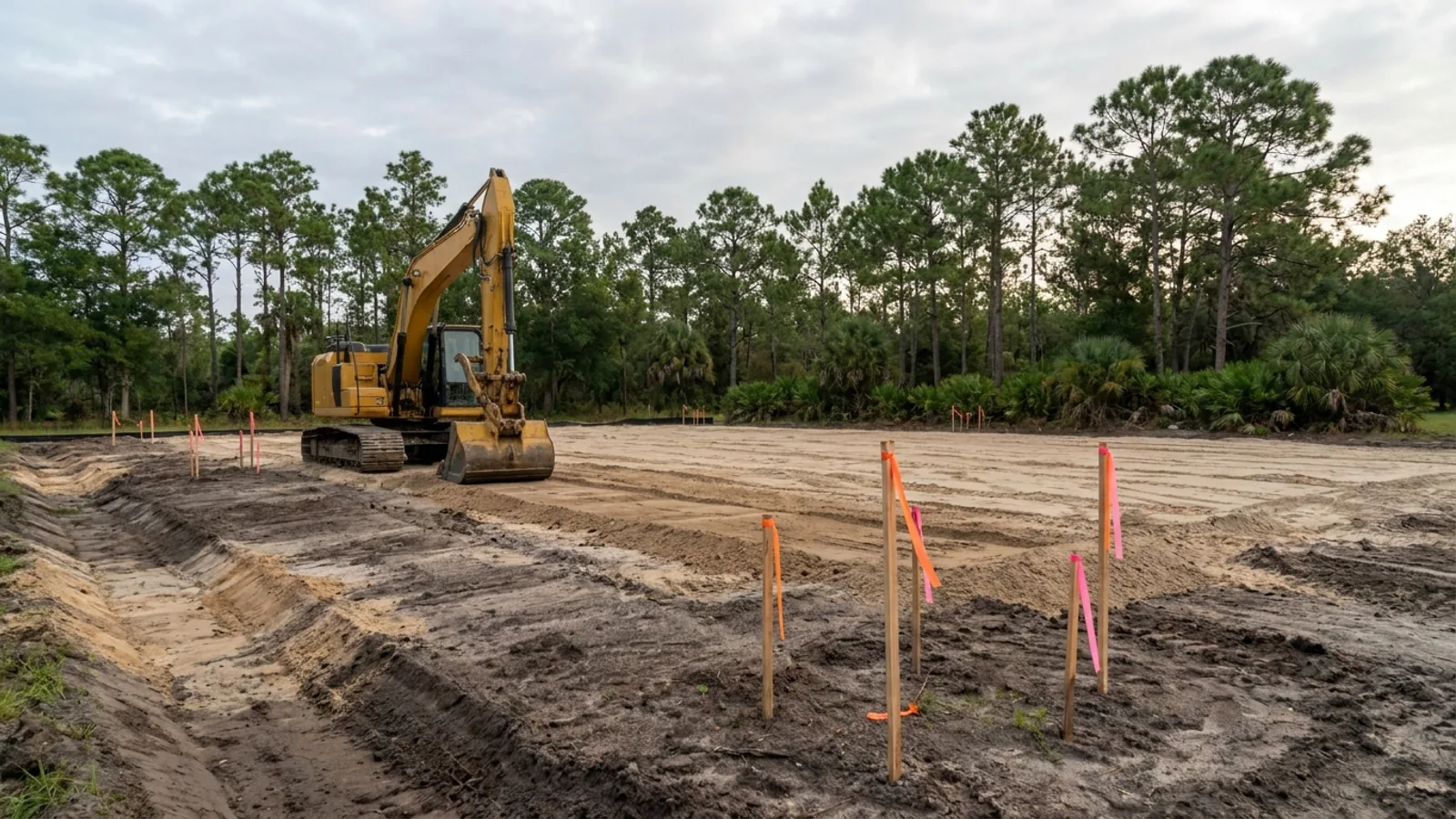
The expensive surprises are in the ground, not the building
Most of Polk County rates poorly for dwellings in the soil survey, and the reason is water sitting close to the surface rather than weak ground. That makes the pad elevation and the drainage plan the two line items most likely to move your budget. We price the dirt before we price the building.
What we build in Lakeland
Every service we offer is available across Polk County, from a shell kit you erect yourself to a finished home we hand you the keys to. What a build costs depends far more on the parcel than on square footage, so we price against your land rather than publishing a rate card.
See all nine servicesWhat a build looks like
Three stages every Lakeland project passes through, from a raw parcel to a finished home. Site work first, because that is where the budget is decided.
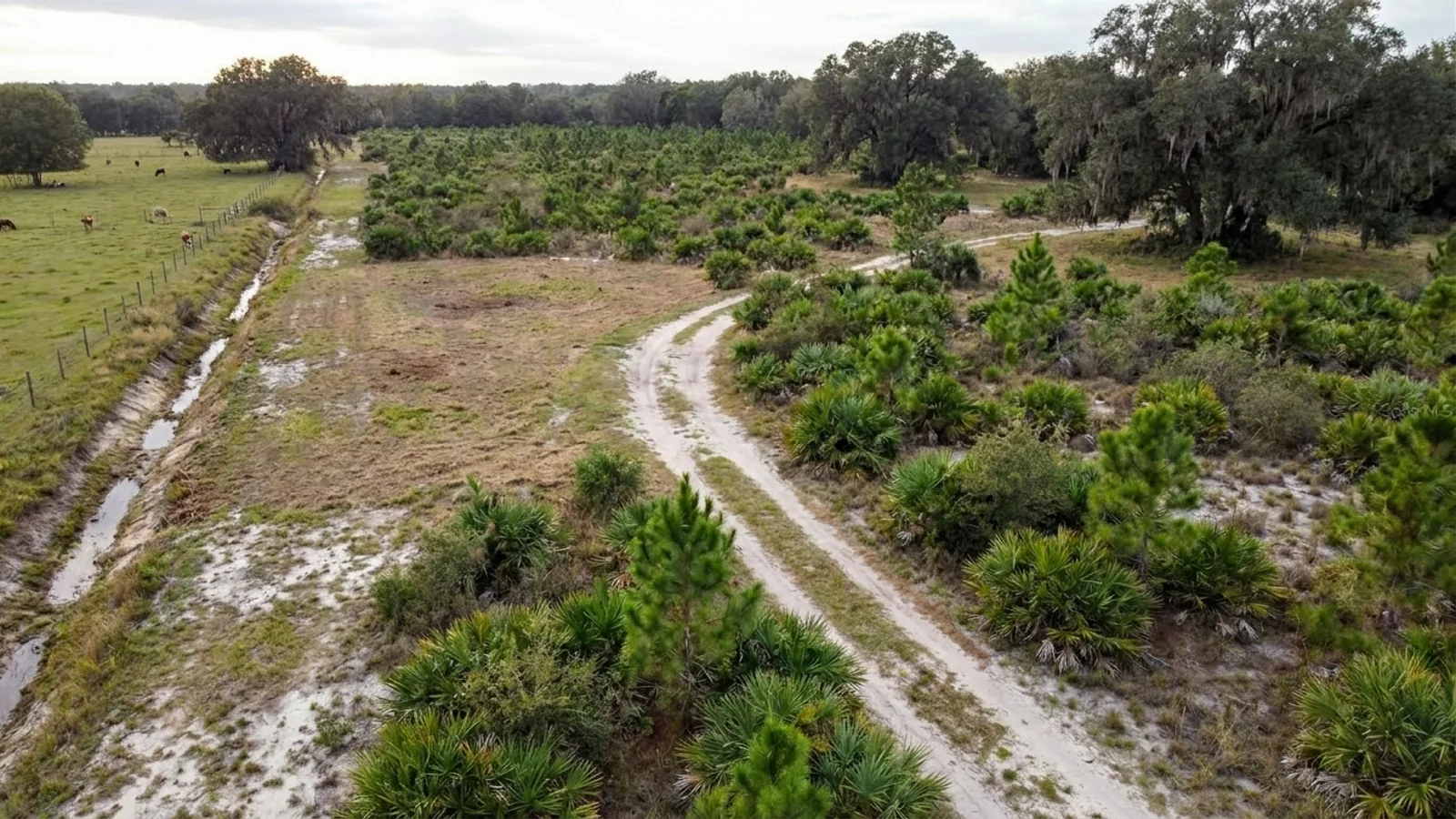
The parcel
Zoning, setbacks, flood zone and utility access get checked before anything is drawn.
Pad and permit
Clearing, grading and a compacted pad, while the submittal works through Polk County.
Frame to finish
Shell erected and dried in, then systems, insulation and interior finish through to CO.
Those are the rules for Polk County. Tell us what you want to build and we will draw it to them.
Where we build around Lakeland
Polk County and the rural land around it. The buildable acreage for a project this size usually sits outside the city limits, which is frequently what changes who issues your permit.
Keep reading
The questions that usually come next once you know what Lakeland allows.
Barndominium Cost Guide
Sourced per-square-foot ranges by tier and by size, with a calculator built on the same figures.
Read itIs It Legal in Florida?
Classification, zoning, the HOA gate, and the agricultural exemption that does not cover a home.
Read itHow Long Does It Take?
Census build-duration data, and the Florida statute capping permit review at 30 business days.
Read itSources for this page
The primary documents behind the Lakeland figures above. We would rather you checked them than took our word for it.
- Polk County Code of OrdinancesZoning districts, minimum lot sizes, setbacks and height limits, as adopted.library.municode.com
- Polk County Building DepartmentThe authority that reviews and issues the permit for unincorporated parcels.polkfl.gov
- Florida Statute 553.792The 30-business-day permit review clock, and the 10% fee reduction per day a jurisdiction runs late.flsenate.gov
- Florida Building CodeThe adopted code itself, including the wind-speed figures and the High Velocity Hurricane Zone definition.floridabuilding.org
- ASCE 7 Hazard ToolLook up the ultimate design wind speed at a specific address rather than reading it off a contour map.asce7hazardtool.online
Nearby areas we build in
Close to Lakeland, though the permitting authority and wind requirements can differ once you cross a county line.
Building in Lakeland: common questions
8 questions we get asked most often about building in Lakeland. If yours is not on the list, ask it directly.
Can I build a shop bigger than the house?
How much land do I need in Polk County?
Do I need impact windows in Polk County?
What wind speed does my building have to meet?
Should I be worried about sinkholes in Polk County?
What is the ground like to build on?
What does the permit cost?
Is Polk County still building?
Building in Lakeland?
Start with the plan. Tell us what you want to build and we will draw it, then confirm what Polk County will actually let you put on the parcel and what wind load it has to meet. That conversation costs nothing.