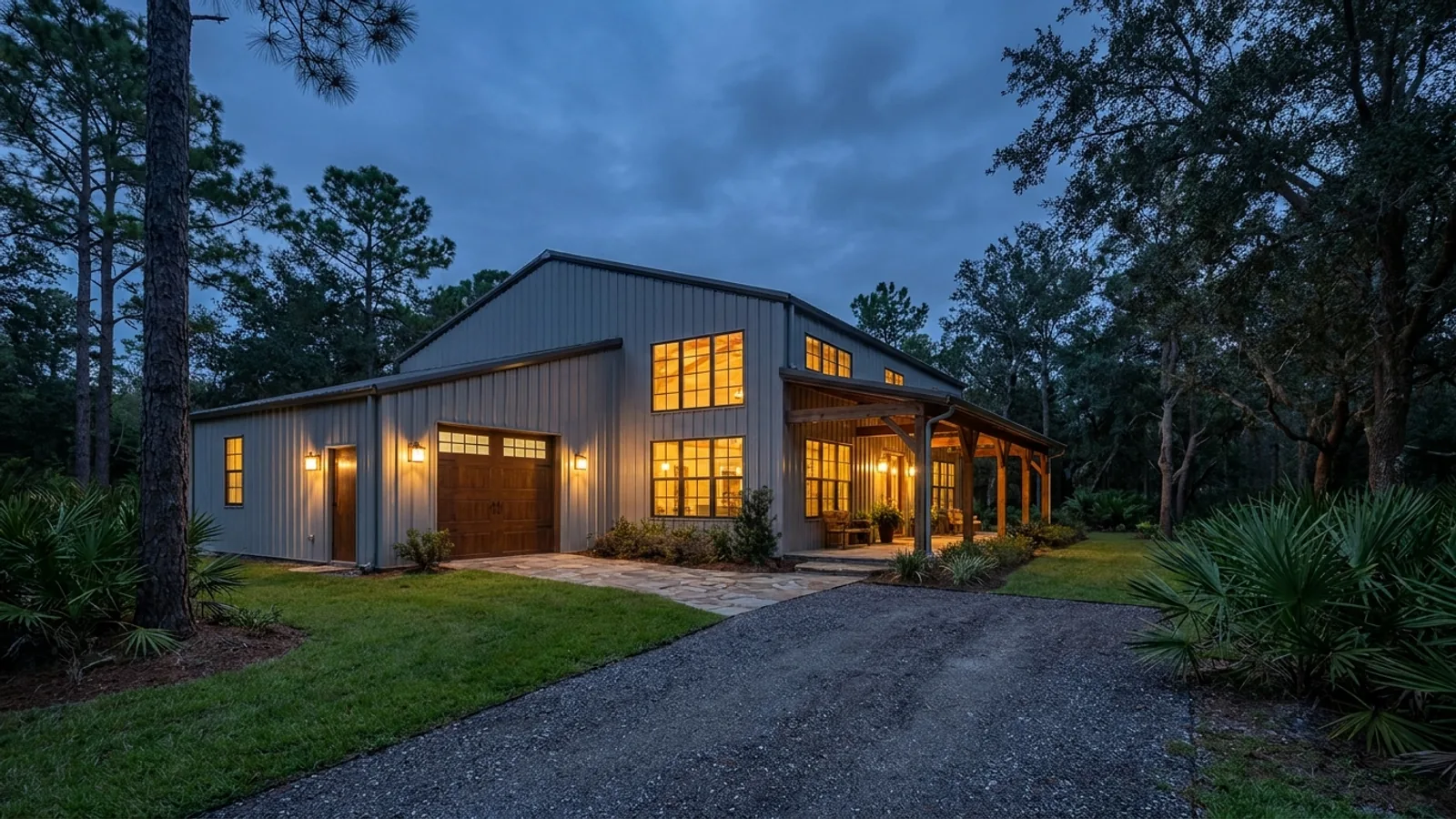
Barndominium Builders in Coral Springs, FL
Coral Springs is a heavily master-planned 1960s-80s suburb, chartered in 1963 as Florida's first master-planned city and essentially built out by the early 2000s, with A-1 (2-acre) and RS-1 (1-acre) estate zoning still on the books but almost no vacant land left to build on them. The one real standing exception is Country Acres, a cluster of roughly 1-to-5-acre lots on the north side of Wiles Road, custom-built mostly in the 1970s, horses permitted, no HOA, and inventory that rarely turns over. We lead with that honestly: the realistic Coral Springs project is a compact steel-framed shouse on a standard 7,000-10,000 sq ft RS-3, RS-4, or RS-5 lot, with Country Acres as a narrow, real option worth knowing about rather than the headline.
Coral Springs at a glance
- County
- Broward County
- Population
- 140,808
- Also serving in Broward County
- Fort Lauderdale, Pembroke Pines, Hollywood, Miramar, Pompano Beach, Davie
Building conditions in Coral Springs
What actually changes from one Florida city to the next: who issues the permit, what wind speed the structure has to be engineered to, and what the ground is like. These are the numbers your drawings have to satisfy.
Coral Springs Land Development Code, Chapter 25, Articles II and IV, Municode Library, codified through Ordinance No. 2025-119 (adopted 3 Dec 2025). Country Acres itself is documented through real-estate listing descriptions, which consistently call it "agricultural zoning" without citing a specific district letter. We verify the exact zoning designation for any specific Country Acres parcel before finalizing a project.
170 mph is the Broward figure per FBC 8th Edition (2023) §1620, confirmed in our Fort Lauderdale/Broward HVHZ research. 175 mph is the Miami-Dade figure and gets wrongly applied to Broward cities including Coral Springs in vendor marketing copy.
City of Coral Springs, "DRC Impact and Developer Fees" page, stated effective 3/1/26. Broward County-level impact fees (school, road, park) are separate county ordinances that apply the same way regardless of Broward city.
Coral Springs Land Development Code, Chapter 6, §606(a).
coralsprings.gov Building Department pages. The city's own DRC fee page states every development needs sign-off from the Broward County Development Management Division (954-357-6666) before a permit issues, but it's unclear whether that applies to every single-family permit or only projects going through formal DRC/site-plan review. We confirm the scope with the Building Division before treating it as a universal extra step on a one-lot barndominium.
Coral Springs Land Development Code §250230, amended by Ord. 2026-104 to conform to F.S. 166.0483 on roof colors, Municode Library. We confirm this directly with Coral Springs Planning & Zoning or the Building Division before finalizing a metal roof design on an RS-1 lot. Chapter 25 also references a separate "Residential Architectural Guidelines" document for roofing materials; it would likely settle this and the broader question of metal exterior siding and wall panels in RS-1 and the standard RS districts. Coral Springs is a heavily HOA-governed, architecturally uniform city, so we don't assume unincorporated Broward's clean metal-exterior answer (no restriction found in County Code Ch. 39) transfers here.
Also worth knowing before you build in Coral Springs
- Two estate-style zoning districts still on the books
- Limited Agricultural (A-1): 2-acre minimum, 125 ft minimum street frontage, 10% max plot coverage, 50 ft setbacks on every side, permits grove/farm/nursery/livestock/beekeeping uses and even an accessory dwelling unit on 2+ acre parcels. Estate (RS-1): 1-acre minimum, 150 ft minimum width, 40 ft max height, 2,500 sq ft minimum floor area, up to 4 horses with a roofed shelter 50 ft from any property line. Both districts are real, current code, they're just almost entirely built out already.
- The realistic target: a 7,000-10,000 sq ft lot, not acreage
- The overwhelming majority of Coral Springs is platted RS-3, RS-4, or RS-5: 10,000, 7,500, and 7,000 sq ft minimum lot sizes respectively, 35 ft max height, 40% max plot coverage. That's the honest target for a compact steel-framed shouse here, a teardown/rebuild or new build on an existing suburban lot, not an acreage build.
- Inside the High Velocity Hurricane Zone, Exposure C is mandatory
- Broward and Miami-Dade are the entire HVHZ, no partial-county lines and no distance-to-coast test, so every Coral Springs address is in it. There's also no Exposure B anywhere in the HVHZ, however sheltered the parcel, a suburban Coral Springs lot that would qualify as Exposure B anywhere else in Florida still has to be engineered to Exposure C.
- What the HVHZ demands of a metal building
- Roof and wall sheets need to be 24 gauge minimum against the 26 and 29 gauge the national kit market runs on, and a Florida-licensed structural engineer has to seal the site-specific adaptation, foundation, and anchorage as one complete system rather than component by component. That's a real barrier to a stock out-of-state metal building package, and a real differentiator for a builder who's already solved it.
- Product approval: both are accepted
- A Miami-Dade Notice of Acceptance is not a legal requirement in Coral Springs. A statewide Florida Product Approval carrying HVHZ approval is equally valid, state law bars a local jurisdiction from demanding further evidence once a product already carries that approval.
- Permit review deadlines, and the private-provider discount
- The 30-business-day review clock and 10% per-business-day fee reduction for a missed deadline apply in Coral Springs exactly as they do anywhere else in Florida, being in the HVHZ doesn't buy the Building Division extra time. Coral Springs also prices its private-provider route concretely: 50% off the plan review and inspection portion of the permit fee if you use a private provider for both, or 25% off for inspection only.
- Building permit fee schedule
- New construction runs on a cumulative bracket structure: a $225 base plus $3.10/sq ft for the first 5,000 sq ft, then a $15,725 base plus $2.91/sq ft from 5,000 to 10,000 sq ft. On top of that: a $0.63-per-$1,000-of-construction-cost education/technology fee, a $609 certificate of occupancy, a $202 reinspection fee, and a $149 plan resubmittal fee.
- Flood insurance discount: we confirm the exact CRS class before quoting a number
- Coral Springs confirms it participates in FEMA's Community Rating System but doesn't publish its specific class number online. Fort Lauderdale's Class 7 (a 15% NFIP discount in AE/AO/AH/VE zones, 10% in Zone X) does not automatically transfer, since each of Broward's 31 municipalities carries its own separate class.
- A fully built-out, master-planned city, not a growth market
- Coral Springs was chartered in 1963 and is frequently described as Florida's first master-planned city, originally planned for 50,000 residents. It's now home to roughly 140,800 people, nearly triple that original plan, and was considered essentially built out by the early 2000s. The market here isn't "room to build," it's teardown/rebuild and accessory-structure retrofit on existing lots, plus the narrow Country Acres exception for a buyer who wants acreage without driving out to Davie or Southwest Ranches.
- New in 2026: offsite construction as of right
- An offsite-constructed residential dwelling now has to be permitted as of right in any zoning district that allows dwellings, which removes a zoning argument that used to stall kit and prefabricated barndominium projects, including in a heavily code-driven, master-planned city like Coral Springs.
Coral Springs Land Development Code, Chapter 25, Article II §§250171-250179 (A-1) and Article IV Division 2 §§250221-250231 (RS-1), Municode Library, codified through Ordinance No. 2025-119.
Coral Springs Land Development Code, Chapter 25, Article IV Division 3 §§250241-250253, Municode Library.
Florida Building Code 8th Edition (2023), §202 definition and §1620.3.
FBC §2223.8.4, §2223.8.5, §2222.4.3, §2223.5, confirmed in our Fort Lauderdale/Broward HVHZ research.
F.S. 553.842, read in full: no HVHZ carve-out, no mention of Broward or Miami-Dade specifically.
F.S. 553.792 and F.S. 553.791, no Coral-Springs-specific carve-out found; City of Coral Springs "Fee Schedule and User Fees" page.
City of Coral Springs "Fee Schedule and User Fees" page. The page itself isn't dated for this section, so we re-verify before quoting an exact number on a specific project, it can change without a visible revision date.
coralsprings.gov Flood Zone Information page. We confirm the actual class by calling the City Engineering Department at 954-345-2160 before quoting a discount percentage.
City of Coral Springs "Founders" page and Wikipedia, cross-checked; population per U.S. Census Bureau Vintage 2024 estimate.
F.S. 553.385, created by HB 803 (Ch. 2026-63), effective 1 July 2026.
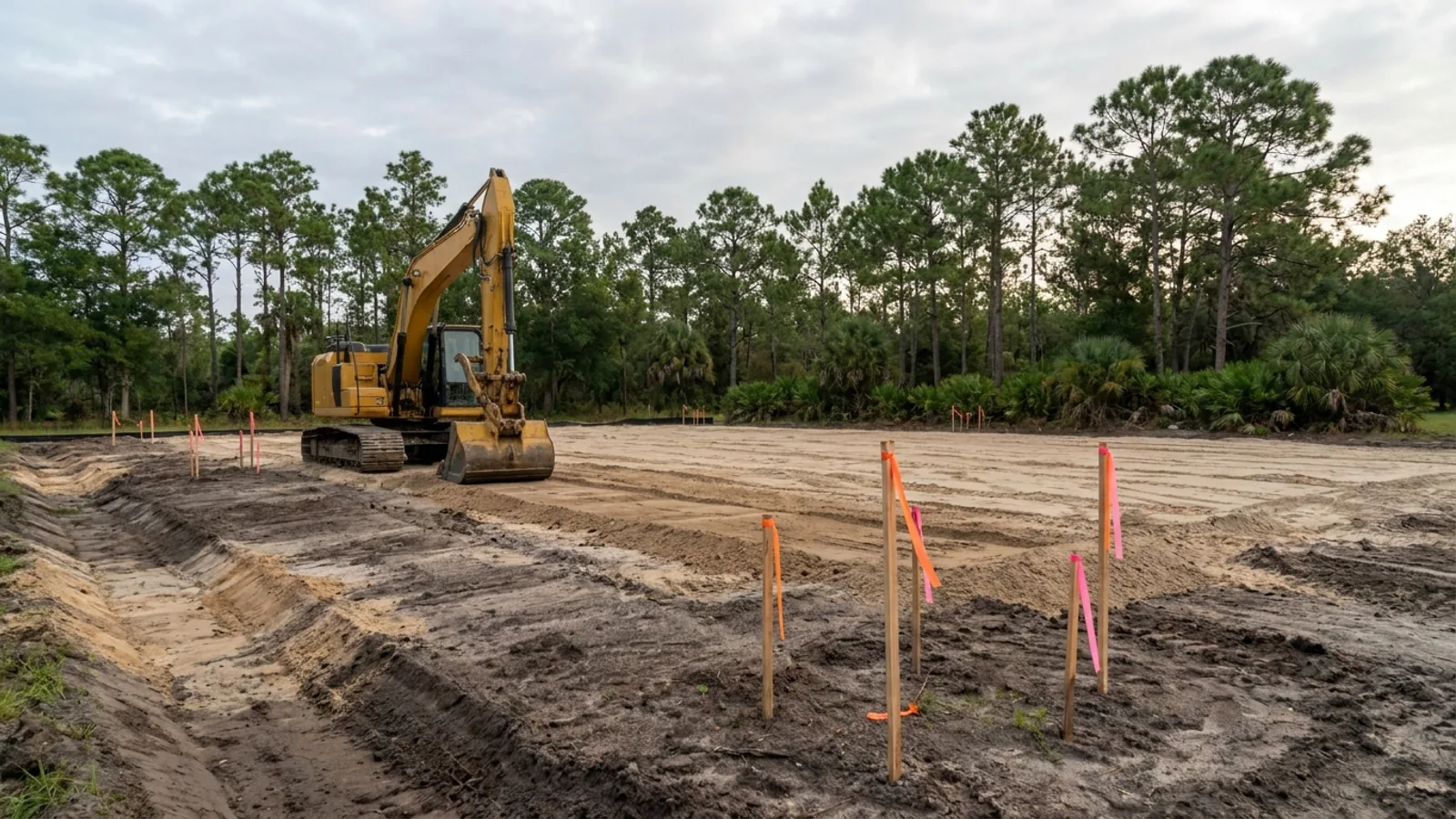
The expensive surprises are in the ground, not the building
Most of Broward County rates poorly for dwellings in the soil survey, and the reason is water sitting close to the surface rather than weak ground. That makes the pad elevation and the drainage plan the two line items most likely to move your budget. We price the dirt before we price the building.
What we build in Coral Springs
Every service we offer is available across Broward County, from a shell kit you erect yourself to a finished home we hand you the keys to. What a build costs depends far more on the parcel than on square footage, so we price against your land rather than publishing a rate card.
See all nine servicesWhat a build looks like
Three stages every Coral Springs project passes through, from a raw parcel to a finished home. Site work first, because that is where the budget is decided.
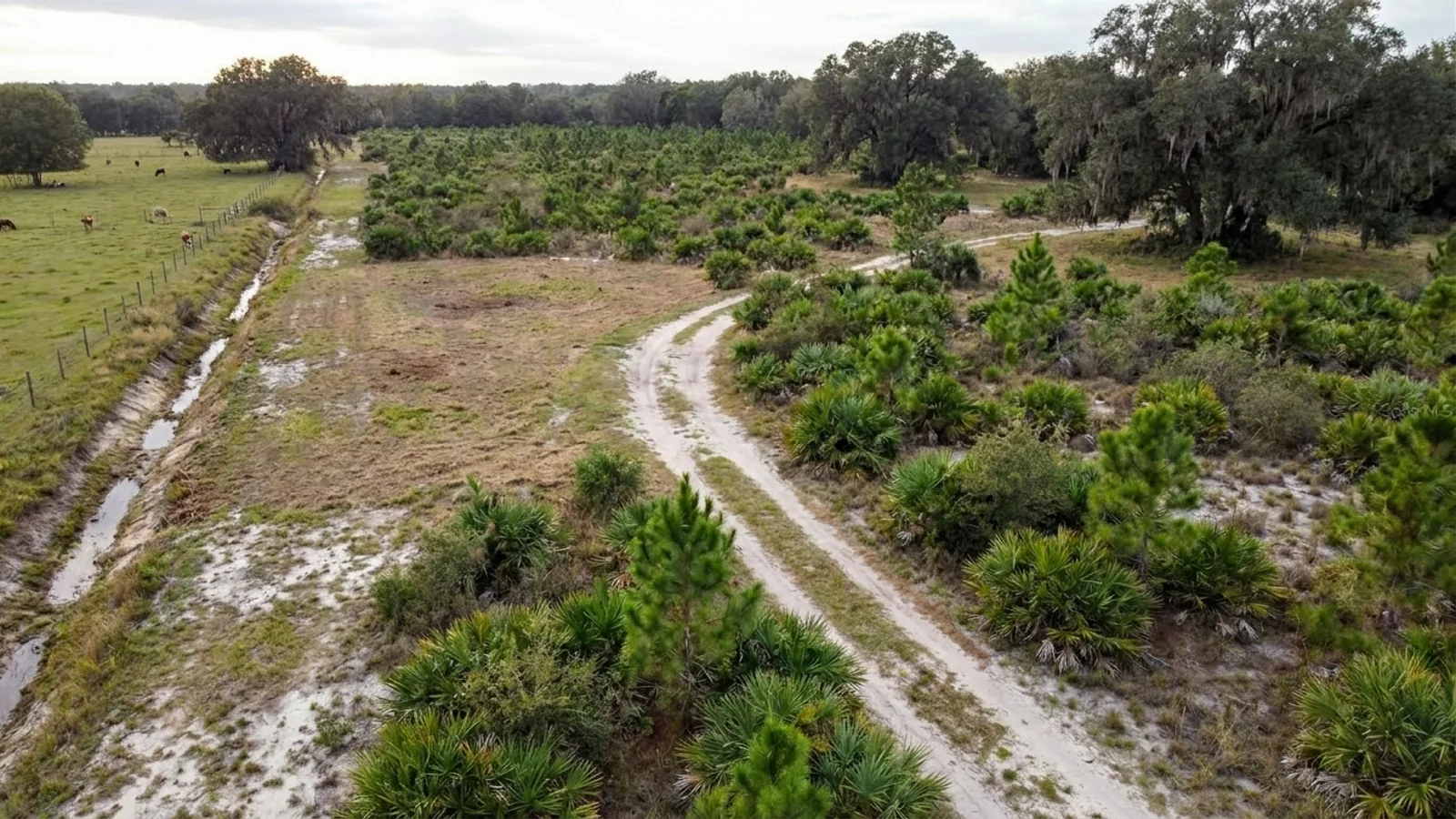
The parcel
Zoning, setbacks, flood zone and utility access get checked before anything is drawn.
Pad and permit
Clearing, grading and a compacted pad, while the submittal works through Broward County.
Frame to finish
Shell erected and dried in, then systems, insulation and interior finish through to CO.
Those are the rules for Broward County. Tell us what you want to build and we will draw it to them.
Where we build around Coral Springs
Broward County and the rural land around it. The buildable acreage for a project this size usually sits outside the city limits, which is frequently what changes who issues your permit.
Keep reading
The questions that usually come next once you know what Coral Springs allows.
Is It Legal in Florida?
Classification, zoning, and what the High Velocity Hurricane Zone actually requires in Broward County.
Read itBarndominium Cost Guide
Sourced ranges by tier, plus the Florida adders that land on top of a national average.
Read itHow Long Does It Take?
Census build-duration data, and the Florida statute capping permit review at 30 business days.
Read itSources for this page
The primary documents behind the Coral Springs figures above. We would rather you checked them than took our word for it.
- Broward County Code of OrdinancesZoning districts, minimum lot sizes, setbacks and height limits, as adopted.library.municode.com
- Broward County Building DepartmentThe authority that reviews and issues the permit for unincorporated parcels.broward.org
- Florida Statute 553.792The 30-business-day permit review clock, and the 10% fee reduction per day a jurisdiction runs late.flsenate.gov
- Florida Building CodeThe adopted code itself, including the wind-speed figures and the High Velocity Hurricane Zone definition.floridabuilding.org
- ASCE 7 Hazard ToolLook up the ultimate design wind speed at a specific address rather than reading it off a contour map.asce7hazardtool.online
Nearby areas we build in
Close to Coral Springs, though the permitting authority and wind requirements can differ once you cross a county line.
Building in Coral Springs: common questions
9 questions we get asked most often about building in Coral Springs. If yours is not on the list, ask it directly.
Is there really any acreage in Coral Springs?
Does Coral Springs zoning actually ban metal roofs on an RS-1 lot?
What's the design wind speed, and does being inland change it?
What does the HVHZ actually require of a metal building here?
Who do I actually deal with to get a permit in Coral Springs?
What will the water and sewer impact fee actually cost me?
Do I have to pay the public art fee on my new home?
What's Coral Springs' flood insurance situation?
Is Coral Springs actually a growth market, or a rebuild market?
Building in Coral Springs?
Start with the plan. Tell us what you want to build and we will draw it, then confirm what Broward County will actually let you put on the parcel and what wind load it has to meet. That conversation costs nothing.