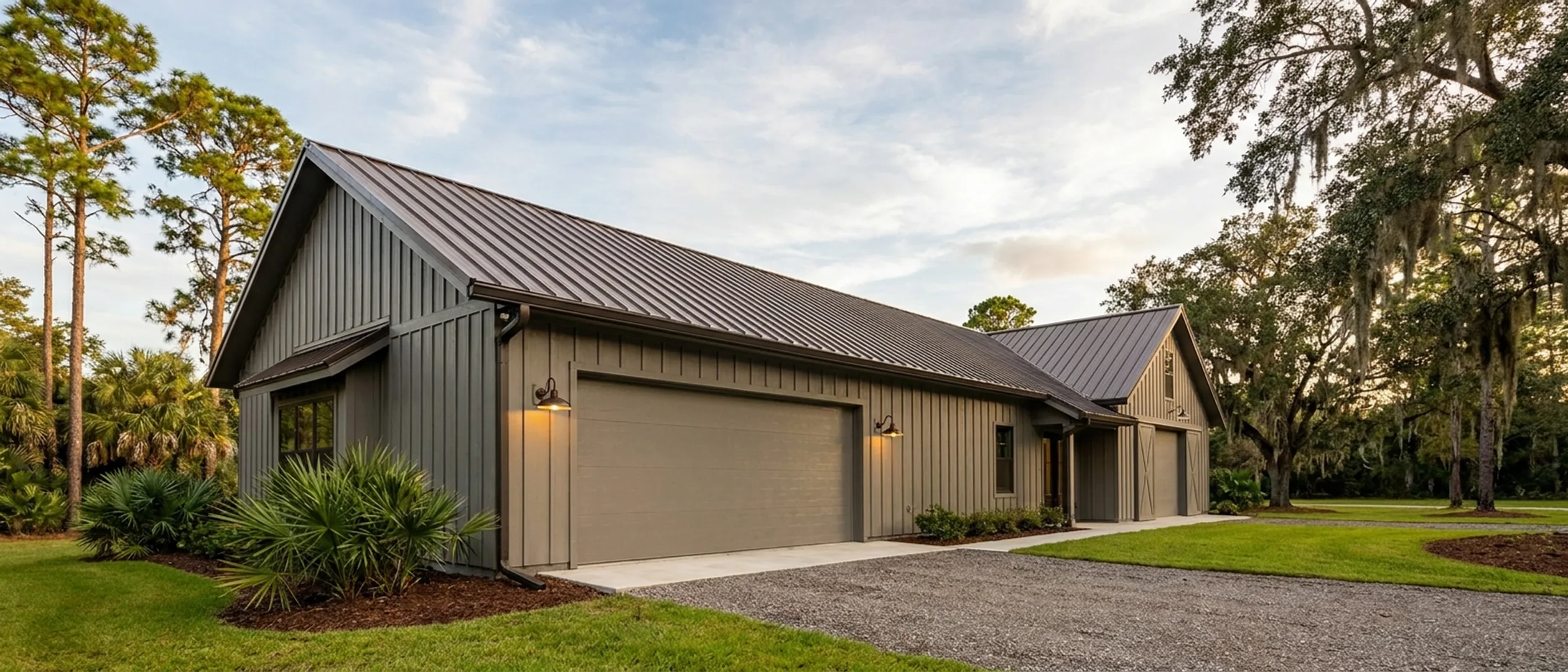
Are Barndominiums Worth It?
This depends far more on your parcel, your finish level and how long you intend to stay than on anything about the building type itself. Our pros and cons guide covers the attributes in detail. This page is about the decision.
Bottom line up front
- Yes on acreage, with a genuine need for shop space, at a mid-grade finish and a long enough hold that resale is not the deciding factor.
- No on a deed-restricted suburban lot at a premium finish with a short hold, which stacks every risk at once.
- The cost advantage is real at 120 to 185 dollars per square foot against 155 for South Atlantic conventional construction, and gone at 225 to 350.
Figures below are industry data from cited third-party sources, not a quote from Florida Barndominium Builders. Every project is priced individually.
Where a barndominium clearly makes sense
The case is strongest when several of these hold together, not when only one does.
You have acreage and a genuine need for shop space
This is the strongest case by a distance. If you would otherwise build a house and then a separate workshop or equipment barn, combining them means one foundation, one roof and one set of utility runs instead of two of each. That consolidation is a real structural saving, not a marketing claim, and it is the reason this building type exists at all.
You want a mid-grade finish rather than a premium one
The cost advantage lives at the mid-grade tier, roughly 120 to 185 dollars per square foot against 155 for South Atlantic conventional construction. At a premium finish of 225 to 350, that advantage is gone entirely. If your finish schedule is heading upmarket, choose this building type because you want the open volume and the shop, not because you are expecting to save money. Our cost comparison has the full breakdown.
You are staying long enough for resale to be secondary
Resale is where the genuine uncertainty sits, and time defuses it. If you intend to be there fifteen years, the thin comparable-sales market matters far less than if you might move in three. The building type is also becoming steadily more common in Florida, which works in your favour over a long hold.
You actually want the open plan
Clear-span structure means very few internal load-bearing walls, so the open volume is genuine rather than a compromise. Tall ceilings and long uninterrupted spans change how a home feels day to day. If you have been in one and liked it, that preference is a perfectly good reason on its own, and it is one conventional construction cannot easily match at the same cost.
Where it is the wrong call
We would rather talk someone out of this than build them something they regret. These are the situations where we would say so.
A deed-restricted suburban lot
An HOA can prohibit metal or barn-style construction through its covenants regardless of county zoning, and on a suburban infill lot you also lose the shop-space rationale that makes the economics work. If the covenants are restrictive and you have no need for workshop space, conventional construction is very likely the better answer.
A premium finish on a short hold
This is the combination that concentrates every risk at once. At premium finish there is no cost advantage to offset the resale uncertainty, and a short hold gives the market no time to develop comparable sales. If you are building to a high specification and might sell within a few years, look hard at conventional construction first.
You are counting on the agricultural exemption
If the plan depends on permitting a barn and finishing living quarters inside it later, it does not work. Florida Statute 604.50 explicitly excludes residential dwellings, and the result is an unpermitted home that cannot be occupied, insured or financed. Our Florida legality guide covers this in full, and it is worth reading before committing to a parcel.
You expect it to be maintenance-free
It is lower maintenance in some respects and not zero maintenance in any. Coating touch-ups, fastener checks on exposed-fastener panels and keeping indoor humidity under control are ongoing habits. If the appeal is that you will never think about the building again, that expectation will not survive contact with reality, whatever a listing claims.
The resale question, answered honestly
This is the part most content on this topic either skips or reassures you about without evidence. Here is what is actually known.
The problem is comparable sales, not the building
Where barndominiums are uncommon, appraisers struggle to find comparable sales and have to widen the search radius, go back further than the usual six months, and sometimes look to another town or county. That produces more variable valuations than a conventional home in an established subdivision would see, and it affects both your buyer's financing and your own.
Well-built and maintained, it should value comparably
The consistent view across appraisal-industry sources is that a barndominium built with standard-or-better materials and properly maintained should value similarly to other homes of comparable size, age and location. The building type is not inherently worth less. It is the thinness of the comparable market that introduces the variance, which is a different problem with a different time horizon.
Rural and suburban markets behave differently
Resale is described as more niche and more volatile in suburban markets than in rural ones, which lines up with where the building type is understood and wanted. On acreage, where buyers are actively looking for shop space, the market is more receptive. On a suburban lot, the buyer pool is narrower. Location does more work here than construction quality does.
What you can do about it
Build to a specification that would be normal for a conventional home in the same price bracket, keep the maintenance records, and avoid highly idiosyncratic layouts that only suit you. Documentation of an engineer-sealed, code-compliant build is genuinely useful at resale, because it answers the first question a cautious buyer or appraiser will ask.
Reading this because you are weighing a build? The next step is a plan drawn for your program.
Pros and cons, honestly
Pros
- Combining home and workshop under one roof, one foundation and one set of utility runs is a real saving against building both separately.
- At mid-grade finish the cost advantage over conventional construction is genuine, roughly 120 to 185 dollars per square foot against 155 in the South Atlantic region.
- Clear-span structure delivers open volume and tall ceilings that conventional framing cannot match as economically.
- Appraisal-industry sources agree a well-built, maintained barndominium should value comparably to other homes of similar size, age and location.
- The building type is becoming steadily more common across Florida, which improves the comparable-sales picture over a long hold.
Cons
- At premium finish, 225 to 350 dollars per square foot, the cost advantage over conventional construction disappears completely.
- Thin comparable sales make valuations more variable, which affects both your financing and your eventual buyer's.
- Resale is described as more niche and more volatile in suburban markets than on rural acreage.
- An HOA can prohibit the building type outright through covenants, independently of county zoning.
- It is lower maintenance, not maintenance-free: coating, fasteners and humidity control are ongoing habits.
Common questions
5 questions people ask most about barndominium cost. If yours is not on the list, ask it directly.
Are barndominiums worth it?
Do barndominiums hold their value?
Will I have trouble selling one?
Is it worth it if I do not need a shop?
What is the single biggest mistake people make?
Questions answered? Tell us what you want to build and we will put real numbers against it.
Keep reading
The pages that answer the next question this one raises.
Barndominium Pros and Cons
The attribute-by-attribute detail behind this decision: maintenance schedules, lifespan data, energy and noise.
Read itCheaper Than a House?
Where the mid-grade cost advantage is real, and the finish level at which it disappears entirely.
Read itIs It Legal in Florida?
Classification, zoning, the HOA gate and the agricultural exemption that does not cover a home.
Read itWant a real number instead of a range?
Start your plans and we will come back with a budget for what you actually want to build, not a national average. Send the parcel ID or an address when you have one and we will price it against your land. That conversation costs nothing.