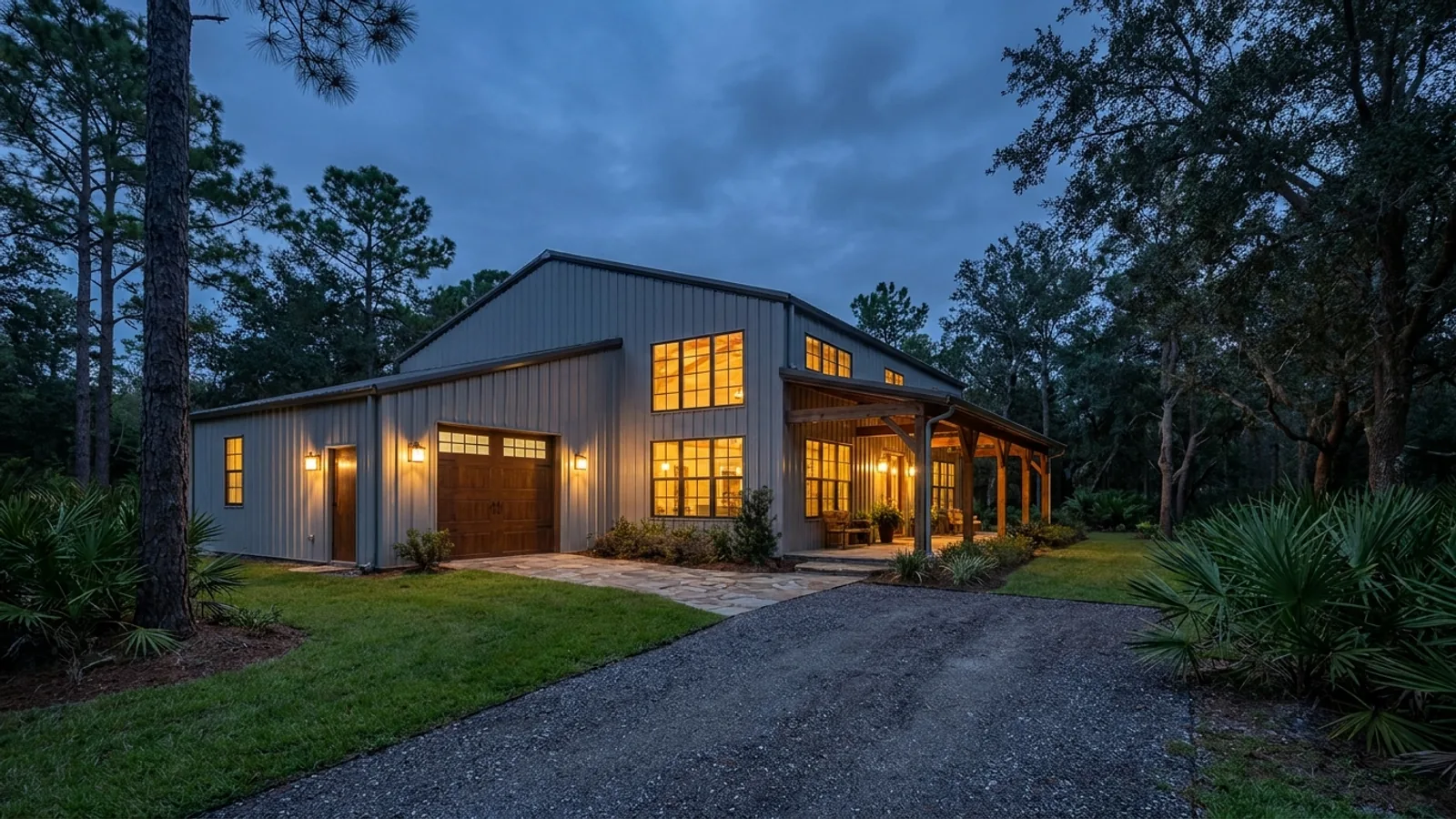
Barndominium Builders in Port St. Lucie, FL
Port St. Lucie is two very different places to build under one name. The city itself is a General Development Corporation-platted grid of more than 80,000 quarter-acre lots sold off starting in 1958, and its own accessory-building rules (a 500 sq ft cap on a detached storage building, 900 to 1,600 sq ft on a garage) confirm it was built for houses, not shops and barns. The barndominium-scale acreage sits west of the city line, in the county's unincorporated AG districts on former citrus grove. Which side of that line you build on does more than change your zoning: the county's own impact fee rate sheet shows the road fee alone runs roughly 2.7 times higher in unincorporated St. Lucie than for an identical home inside city limits, the opposite of what most buyers assume.
Building conditions in Port St. Lucie
What actually changes from one Florida city to the next: who issues the permit, what wind speed the structure has to be engineered to, and what the ground is like. These are the numbers your drawings have to satisfy.
City of Port St. Lucie Building Department; St. Lucie County Planning & Development Services, current as of August 2026.
St. Lucie County Land Development Code, Chapter III § 3.01.03 and Table 7-10 / § 7.04.01, via the county's official code mirror (stluciecounty.elaws.us).
City of Port St. Lucie Building Department, "2010 Florida Building Code Wind Zones" fact sheet, citing FBC Table 1609.3.1 (Vult, Risk Category II).
St. Lucie County official Impact Fee Rate Sheet, effective 1/1/2025-9/30/2025, road fees per the county's 2022 impact fee study (adopted 19 April 2022). The City of Port St. Lucie's own June-2025 schedule shows slightly different Parks/Public Buildings/Law Enforcement figures than the county sheet, We confirm which schedule governs a city-limits project with both the City Building Department and County Impact Fee Office before quoting a client a final number.
Florida Geological Survey / FDEP Subsidence Incident Reports, queried directly against the ca.dep.state.fl.us ArcGIS feature service.
U.S. Census Bureau Vintage 2025 Population Estimates, as reported by MIAMI REALTORS®/RWorld analysis.
Also worth knowing before you build in Port St. Lucie
- A quarter-million platted lots, and where the real acreage is
- General Development Corporation platted more than 80,000 quarter-acre lots across what is now the City of Port St. Lucie starting in 1958, sold mostly to distant buyers and originally served by private well and septic. GDC's utility went bankrupt in 1990 and the county took over the system by eminent domain. Many of those original lots remain vacant today, and it's this legacy that makes the platted city itself a house-lot market, not an acreage market.
- Soil tells two different stories depending on where you sit
- The county's dominant Wabasso and Myakka soils are the same poorly-drained flatwoods Spodosols found across most of the Treasure Coast. But St. Lucie is also the namesake type-area for the "St. Lucie" soil series, an excessively drained sand found on the old coastal dunes and ridges, with very high permeability. Site position, ridge versus flatwoods, changes the drainage story more here than a single county-wide generalization would suggest.
- City flood insurance discount
- The City of Port St. Lucie holds a Community Rating System Class 5, upgraded from Class 8 in November 2022, earning policyholders in the flood hazard area up to 25% off NFIP premiums and 10% off outside it. Fewer than 18% of Florida's roughly 250 CRS communities hold a Class 5 or better.
- Outside the High Velocity Hurricane Zone
- Only Miami-Dade and Broward counties are the HVHZ. St. Lucie County is not among them and never has been.
- The agricultural exemption does not cover a dwelling
- F.S. 604.50 exempts a bona fide farm building, barn, or storage structure from the building code and permit fees, but never a structure intended as a residence. No local St. Lucie ordinance broadens that for a barndominium built on AG land.
- Where the city's rules give away its house-lot design
- Inside city limits, accessory uses cap out at 20% of the principal building's floor area (whichever is more restrictive against 20% of lot area). A detached storage building tops out at 500 sq ft, a garage at 900 sq ft on lots under 18,500 sq ft or 1,600 sq ft on larger lots, and garage height can't exceed the house roofline or 22 feet. Structures over 300 sq ft must match the principal structure's materials and design. None of this is the AG districts' regime.
- Single-family permit fees use the ICC valuation table, not a flat schedule
- Inside the city, a single-family building permit fee is calculated from the International Code Council's valuation-per-square-foot table, updated twice a year, not a fixed dollar figure. Plan review runs 11% of the permit fee, and an owner acting as their own contractor pays an added 15% surcharge. Unincorporated St. Lucie County uses its own building permit fee schedule under Resolution 2025-93.
- Citrus land is why there is acreage to build on
- St. Lucie County lost more citrus acreage than any other Florida county between 2003-04 and 2021-22, down to 2,656 acres by the 2022-23 crop year from a much larger historical base. Citrus greening disease, Brazilian competition, and grower buyouts by developers all played a part, and it's a lot of that former grove land, now zoned AG west of the city, that barndominium buyers are looking at today.
- Hurricane record: two direct hits, both well under design speed
- Hurricane Frances made landfall nearby in September 2004 as a Category 2, and moved so slowly across the Treasure Coast that St. Lucie County endured roughly 12 hours of sustained hurricane-force wind, damaging over 28,000 homes despite its modest category. Hurricane Nicole made landfall at the Indian River/St. Lucie county line in November 2022 as a Category 1. Both storms came in well under the 150 mph design figure, which is a 700-year statistical value, not a forecast.
- Permit review deadline and the private-provider route
- A single-family home under 7,500 sq ft gets a 30-business-day review clock, or the jurisdiction has to cut the permit fee by 10% per business day late, the same statewide rule as everywhere else. Both the city and county advertise a private-provider option under F.S. 553.791 (local private providers cite roughly 24-hour single-family turnaround), but neither publishes a specific fee discount the way Palm Bay's flat $250/$250 or Gainesville's 75% off do.
- Rainfall
- 53.84 inches a year, 73.0°F mean annual temperature.
- Median single-family sale price
- Ranged from $389,000 in January 2026 to $407,000 in March 2026, and sat at $400,000 in August 2026, down 1.6% year over year. This is secondary MLS-based reporting, not a primary government figure.
Multiple corroborating historical accounts (Florida Tech post-storm research archive, Grokipedia, St. Lucie Record local history project).
USDA-NRCS Official Series Description, "St. Lucie" series (moderate extent in MLRA 154/155, which includes St. Lucie County).
City of Port St. Lucie press materials (cityofpsl.gov news archive), corroborated by WQCS and WPTV coverage of the November 2022 FEMA announcement.
Florida Building Code, Section 202 definitions.
F.S. 604.50; statewide rule, no local St. Lucie carve-out found.
City of Port St. Lucie Code of Ordinances § 158.217.
City of Port St. Lucie Code of Ordinances § 150.702. We confirm the applicable unincorporated-county fee schedule with St. Lucie County Planning & Development Services as part of every project's cost estimate.
USDA NASS Commercial Citrus Inventory, 2022-23 crop year (primary, 2,656 acres figure); older historical acreage figures are secondary-sourced (Citrus Industry Magazine, citing NASS).
National Hurricane Center Tropical Cyclone Reports AL062004 (Frances) and AL172022 (Nicole), corroborated by NWS Melbourne post-storm surveys and contemporaneous news reporting.
F.S. 553.792 (as amended by HB 267, effective 1 January 2025); F.S. 553.791. We confirm the current private-provider discount with each jurisdiction as part of project planning.
NOAA NCEI 1991-2020 Climate Normals, station USW00012895 (Fort Pierce St. Lucie County International Airport).
Realtor association / MLS reporting, 2026.
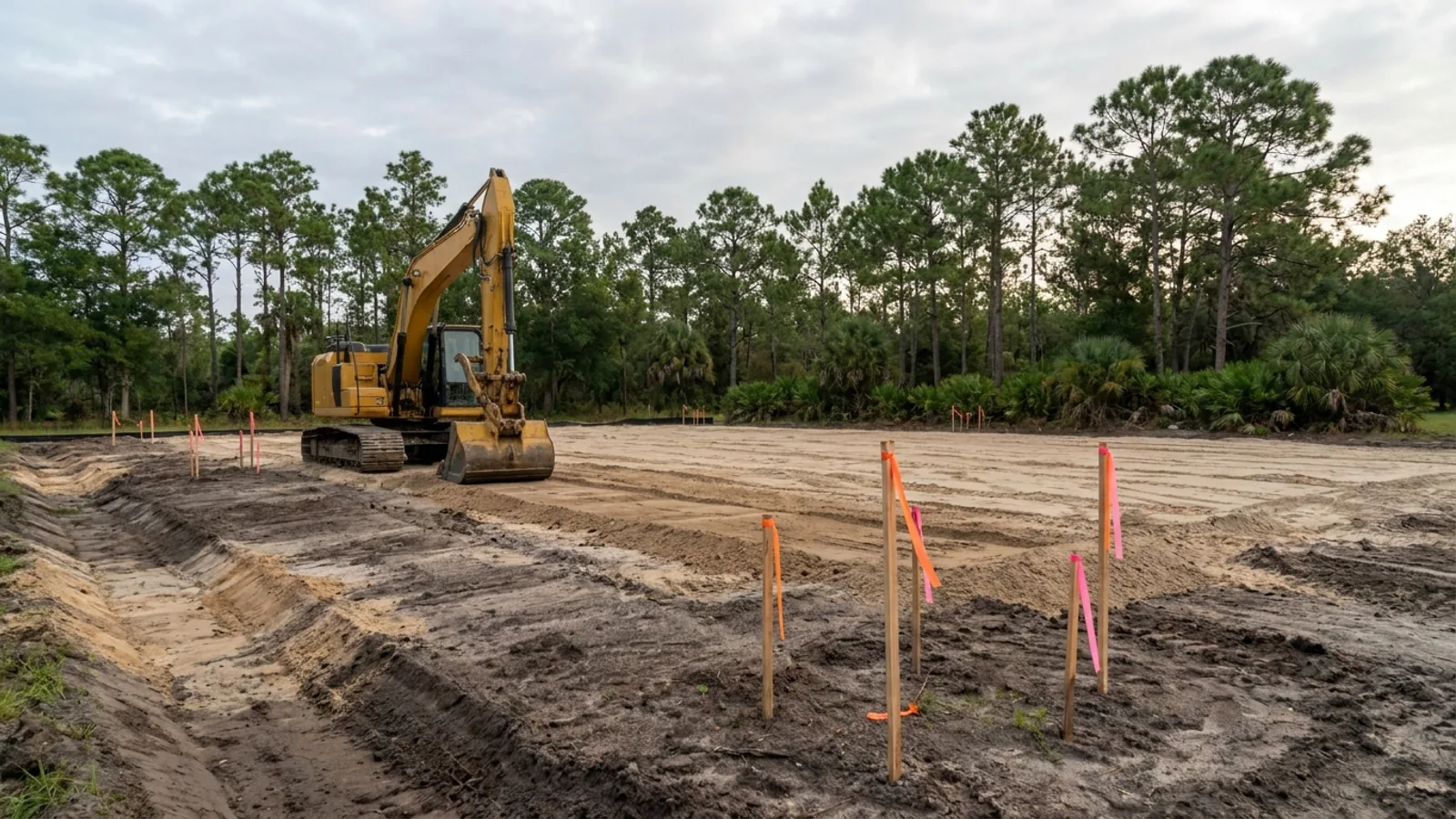
The expensive surprises are in the ground, not the building
Most of St. Lucie County rates poorly for dwellings in the soil survey, and the reason is water sitting close to the surface rather than weak ground. That makes the pad elevation and the drainage plan the two line items most likely to move your budget. We price the dirt before we price the building.
What we build in Port St. Lucie
Every service we offer is available across St. Lucie County, from a shell kit you erect yourself to a finished home we hand you the keys to. What a build costs depends far more on the parcel than on square footage, so we price against your land rather than publishing a rate card.
See all nine servicesWhat a build looks like
Three stages every Port St. Lucie project passes through, from a raw parcel to a finished home. Site work first, because that is where the budget is decided.
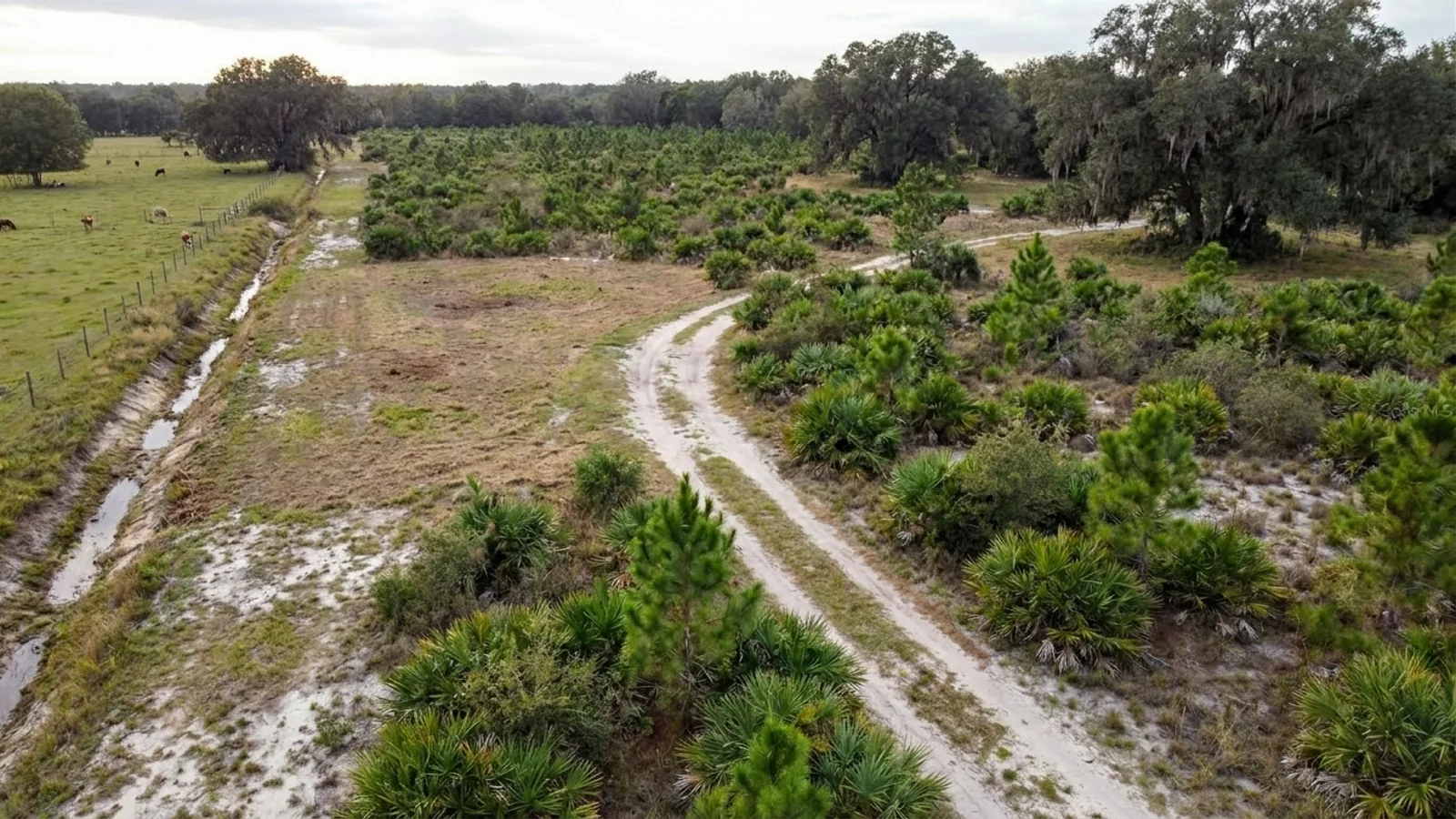
The parcel
Zoning, setbacks, flood zone and utility access get checked before anything is drawn.
Pad and permit
Clearing, grading and a compacted pad, while the submittal works through St. Lucie County.
Frame to finish
Shell erected and dried in, then systems, insulation and interior finish through to CO.
Those are the rules for St. Lucie County. Tell us what you want to build and we will draw it to them.
Where we build around Port St. Lucie
St. Lucie County and the rural land around it. The buildable acreage for a project this size usually sits outside the city limits, which is frequently what changes who issues your permit.
Keep reading
The questions that usually come next once you know what Port St. Lucie allows.
Barndominium Cost Guide
Sourced per-square-foot ranges by tier and by size, with a calculator built on the same figures.
Read itIs It Legal in Florida?
Classification, zoning, the HOA gate, and the agricultural exemption that does not cover a home.
Read itHow Long Does It Take?
Census build-duration data, and the Florida statute capping permit review at 30 business days.
Read itSources for this page
The primary documents behind the Port St. Lucie figures above. We would rather you checked them than took our word for it.
- St. Lucie County Code of OrdinancesZoning districts, minimum lot sizes, setbacks and height limits, as adopted.library.municode.com
- Florida Statute 553.792The 30-business-day permit review clock, and the 10% fee reduction per day a jurisdiction runs late.flsenate.gov
- Florida Building CodeThe adopted code itself, including the wind-speed figures and the High Velocity Hurricane Zone definition.floridabuilding.org
- ASCE 7 Hazard ToolLook up the ultimate design wind speed at a specific address rather than reading it off a contour map.asce7hazardtool.online
- Florida Statute 604.50The nonresidential farm building exemption, and its explicit carve-out of residential dwellings.flsenate.gov
Nearby areas we build in
Close to Port St. Lucie, though the permitting authority and wind requirements can differ once you cross a county line.
Building in Port St. Lucie: common questions
11 questions we get asked most often about building in Port St. Lucie. If yours is not on the list, ask it directly.
Should I build inside Port St. Lucie or in the unincorporated county?
How much land do I need, and what zoning applies?
Is it true county impact fees cost more than city fees here?
What wind speed does my building need to be engineered to?
Is Port St. Lucie in Florida's High Velocity Hurricane Zone?
How worried should I be about sinkholes?
What are the soil and drainage conditions like?
How long does permitting take, and is there a faster route?
What's driving all the growth in Port St. Lucie, and does it affect land prices?
Can I use the agricultural exemption to skip the building permit process?
What should I know about hurricane risk here specifically?
Building in Port St. Lucie?
Start with the plan. Tell us what you want to build and we will draw it, then confirm what St. Lucie County will actually let you put on the parcel and what wind load it has to meet. That conversation costs nothing.