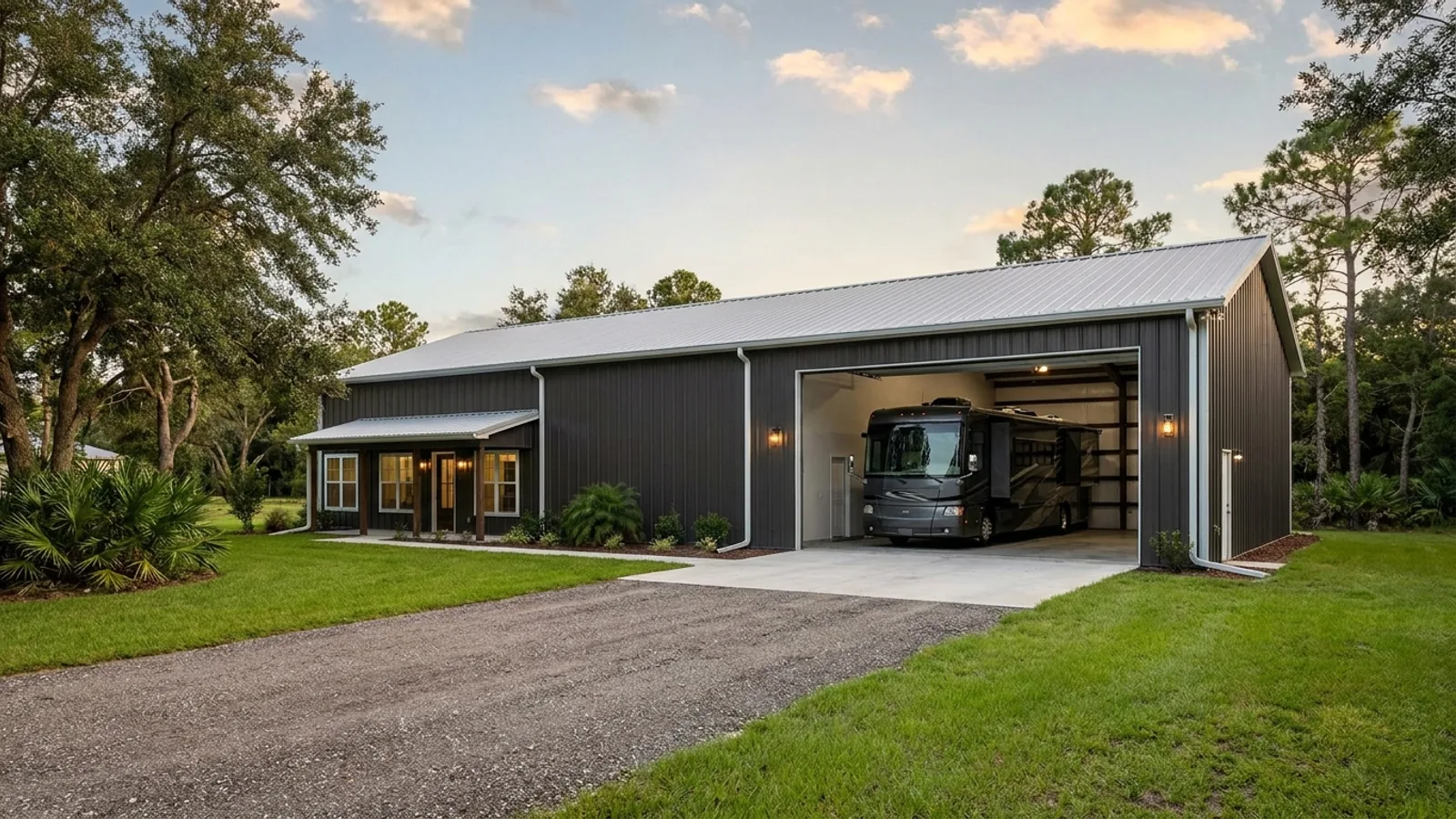
RV Barndominium in Florida
"RV barndominium" isn't a formal building category, no code body defines it, it's a design pattern where a large RV bay is the building's primary program element rather than an afterthought. What that actually takes is bigger than most people plan for: a real Class A coach can run 45 feet long, which means the bay needs roughly 50 feet of clear depth, closer to the building's full length than its width. Get that number right first and the rest of the layout follows.
What actually changes with this feature
The look is the easy part. These are the decisions that follow from it.
Bay depth is the real constraint
Class A coaches run up to 45 ft. Add a workable front and rear clearance and a comfortable bay needs roughly 50-57 ft of clear interior depth, tight storage-only fits can get away with less, but not much less. That runs the long dimension of the building, not the width.
Pull-through bays cost more than one extra door
Doors on both ends means both end walls lose shear capacity at the same time, instead of one solid wall carrying the lateral bracing while the other has the opening. That bracing has to be engineered elsewhere in the building. Ask for a price on this specifically rather than assuming it's a simple add.
Hookups: power, water, sewer
A 50-amp pedestal connection, hot and cold hose bibs with a utility sink, and a capped sewer inlet are the standard package. Route the sewer dump to the outside of the bay rather than inside it, real owners report indoor dump connections as a genuine, recurring odor problem worth avoiding at the design stage.
An enclosed bay is a garage, code-wise
Florida code draws a hard line: a carport open on fewer than two sides is classified and permitted as a garage. The moment your RV bay is enclosed on three or more sides under the main roof, it's a garage in the code's eyes, which triggers the same dwelling-garage fire separation a shop bay needs, not a lighter standard because it's sized for an RV.
A 45-foot coach needs roughly 50 feet of bay depth, not just a tall enough door
Most RV-bay content fixates on door height and stops there. The real constraint is depth: a large Class A coach plus a workable front and rear clearance runs close to 50 feet, which has to come out of the building's long dimension, not its width. On a 40x60 footprint, that's most of the 60-foot run consumed by the bay alone, which changes how much room is actually left for a shop or extra living space. We size the bay to your specific coach before we size anything else.
Common ways to build this
Common configurations we see. Yours does not have to match one exactly — this is a starting point for the conversation, not a catalog.
Single RV bay plus a car bay
~50-57 ft RV depth + a standard vehicle bay
The most common real configuration: one deep bay sized to the coach, one normal-depth bay alongside it for a daily vehicle. Ceiling height and door size follow from the RV; the car bay doesn't need to match it.
Pull-through bay
overhead doors on both ends
Drive straight through instead of backing in. Needs engineered lateral bracing since both end walls carry an opening at once, and driveway access at both ends of the building, not just one.
RV port vs. enclosed garage
open-sided carport vs. fully enclosed bay
An open-sided port permits on the lighter carport path. Enclose it on three or more sides, which is what most people actually mean by "RV barndominium," and it's a garage under Florida code, with the fire separation that classification requires.
Ways to build this size
A footprint can go together several ways. These are the service lines most relevant to it.
Shouses
Shop and house in one building: workspace and living space under a single roof and a single permit.
Read moreSteel Construction
Red-iron and light-gauge steel framing: no rot, no termites, engineered for hurricane wind loads.
Read moreCustom Plans
Barndominium floor plans drawn to your land, your family, and Florida code.
Read moreRV Barndominium: common questions
6 questions we get asked most often about this footprint. If yours is not on the list, ask it directly.
How deep does an RV bay actually need to be?
Is 'RV barndominium' a special type of building?
What's a pull-through bay and is it worth the extra cost?
Can I run power, water, and sewer to my RV bay?
Does an RV bay need the same fire separation as a shop?
Is Florida actually a big market for this, or is that just marketing?
Keep reading
The pages that answer the next question this one raises.
Want this drawn for your program and your parcel? That is where a build actually starts.
Start your plans
Tell us what you want to build and we will draw this for your program, then confirm what it looks like on your parcel, the wind load it has to meet, and a realistic budget range. That conversation costs nothing.